
The basics of Zoo Dermatology

The basics of Zoo Dermatology
Comprehensive scientific background to better understand dog skin and fur
The different layers of the skin
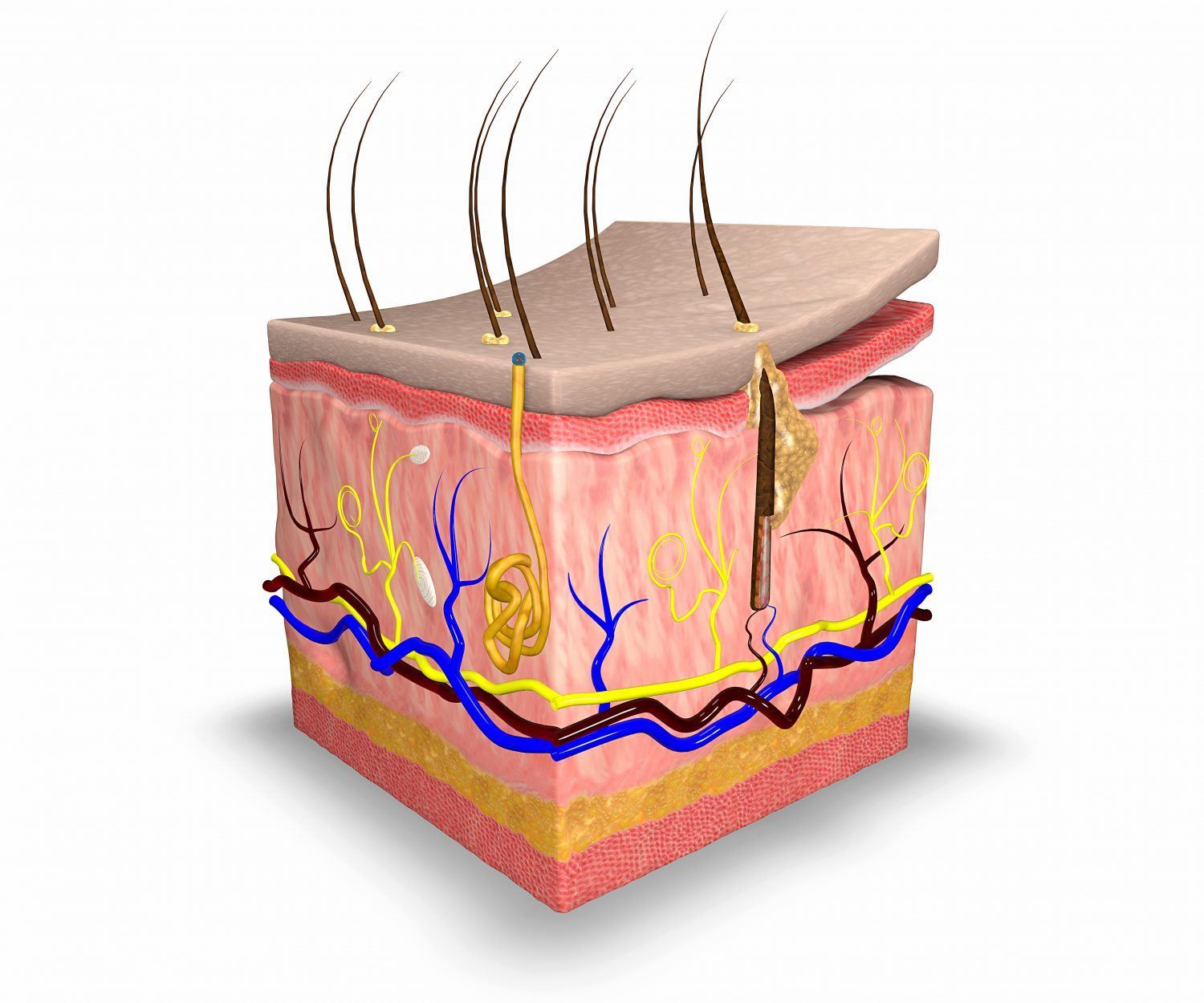
Epidermis : It consists of four layers:
o the germinal layer, the deepest layer, made up of the keratinocytes, cells responsible for the renewal of the epidermis, eliminated by desquamation (scales, dandruff) and melanocytes, specialized cells producing pigments (melanins);
o Malpighi's layer;
o the granular layer;
o the stratum corneum, formed of dead cells (scales) stacked
layered one on top of the other and containing keratin. This layer is very thick at the level of the toe pads.
Dermis : It comprises two layers: the papillary dermis and the reticular dermis.
It is the dermis that determines skin thickness.
Hypodermis : Much looser than the dermis, it allows the mobilization of the skin by the platysma muscles. It seems particularly developed in
in some areas (folds of the stifle, lips...) and absent in others (lips, cheeks, eyelids...).
The hair
A dog's coat is a complex system made up of hairs of different types.
types that almost completely cover the surface of the body.
Anatomically, hair comprises four parts:
o the hair bulb;
o the root;
o the stem;
o the tip of the hair.
Histologically, the hair is composed of three zones:
o a central medullary zone;
o a peripheral cortical zone;
o a scaly cuticle.
The skin sheath that surrounds the root of the hair is called the hair follicle.
In adult dogs, the hairs are grouped into follicular groups: each group The follicular unit comprises a single primary hair (cover hair), long and stiff, and hairs Secondary hairs (underhairs) are fine and flexible. These include hairs of the caudal gland and sensory hairs. are never grouped together. Generally speaking, we distinguish:
o the guard hairs (cover or guard hairs), long, broad, pigmented and
stiff;
o the undercoat (fur or down), fine, short, dense, sparse or not
pigmented;
o very fine and very long woolly hairs.
Hair length (itself linked to the growth rate) and variations in The length and number of primary and secondary hairs result in the different types of coat.
Hair renewal occurs according to a specific cycle: the "hair cycle," which comprises three phases:
o the growth phase (anagen phase), the duration of which determines the coat length;
o the arrest phase (telogen phase), which lasts several months;
o the intermediate phase (catagen phase): a new hair begins its
growth and pushes the old hair outwards from the hair follicle.
The hair growth cycle is under genetic control, but environmental factors
(Ambient temperature, photoperiodism) are also important. The length of the cycle
varies according to breed and body region, resulting in different coat types.
Hair appendages
Sebaceous glands are associated with hair follicles: these are called pilosebaceous follicles. They produce sebum. In dogs, the sebaceous glands are large and particularly developed in regions where the hair is short and in areas of cutaneous-mucosal junctions. They are absent on the nose and paw pads. plantar.
On the dorsal side of the tail (at the level of the 8th caudal vertebra) is present oval area covered with longer, isolated and stiff hairs, associated with sebaceous glands large. The whole is improperly called "the caudal gland".
The sweat glands are less developed than in humans. They have essentially an ethological role through the odor of their secretion product and do not play no role in thermoregulation unlike their role in humans.
The arrector pili muscles, developed in the skin of the back, are the origin of the bristling of the hairs.
The surface skin film
The skin is covered with a surface cutaneous film (9) which plays a key role in the
maintenance of the skin ecosystem.
This surface skin film is composed of:
• lipids: we distinguish:
o Glandular lipids, which come mainly from secretion Sebaceous glands: sebum. This contains various lipids: cholesterol, waxes and diesters, and labile fatty acids. Secretion The sebaceous gland is essentially under hormonal control, but... Trauma and irritation increase secretion.
o Strict epidermal lipids, which originate from the epidermis, including the Intercellular elements are rich in lipids.
• of corneal cells: keratinocytes undergo a program of differentiation and maturation from the germinal layer: the Keratinization. Keratinization results in the formation of dead cells. flattened (corneal cells): the scales (dandruff). This stratum corneum is a barrier between the organism and the environment before being eliminated by the Peeling occurs in 25-30 days.
In conclusion, the surface skin film is an emulsion made up of lipids.
(sebaceous and epidermal) and corneal cells.
The main functions of a dog's skin
The main functions of the skin (3) are:
• the protection of the internal environment by maintaining an effective barrier,
• protection against external aggressions (physical, chemical, microbiological),
• the storage of water, electrolytes, vitamins, fatty acids, proteins, carbohydrates…
• Immunoregistration (defense against microorganisms, reactions) inflammatory),
• secretions,
• sensory perception, vitamin D production (bone formation).
The skin therefore has many functions that make it a vital organ. It is The interface between the internal environment and the external environment. The skin, and in particular the epidermis, It presents a barrier to the outside world and constitutes a defense system for the environment. A very effective internal barrier or protection system, anatomical, chemical,
Antibacterial and immunological.
The skin: anatomical protection
Protection against external aggressions
The skin is, by its very nature, a 'barrier organ' that prevents the penetration of elements
foreign to the body, but also allows it to retain all the elements of the body (water,
ions, molecules). It is the epidermis, and more specifically the stratum corneum, that plays this role.
primary mechanical role of protection against external aggressions.
Protection against dehydration
The surface film of the skin plays a major role in the hydration status of the epidermis.
which is normally 10%. Although low compared to that of other skin elements,
This hydration of the stratum corneum is key to the health and aesthetics of the skin.
The epidermis is generally impermeable to water due to its richness in lipids.
However, under normal conditions, the epidermis is not completely impermeable to water:
o there is always a slight loss of water to the outside, while the Water penetration is extremely low. On the other hand, healthy skin is Impermeable to proteins and slightly permeable to small molecules dimensions;
o these losses increase during epidermal lesions with an adverse effect self-acceleration: dehydration of the epidermis reduces its impermeability and worsens in proportion to the water losses which in result.
Conclusion
Rehydrating the epidermis and the resulting waterproofing constitutes an act major in dermatology
The skin: chemical protection
The skin creates a chemical barrier through its surface lipid film.
In dogs, free fatty acids, present in very small quantities, come from a Enzymatic lipolysis by surface saprophytic bacteria and are involved in the regulation of skin pH which varies from 5.2 to 7.2 (depending on the area of the body and probably (depending on the race). This pH is much less acidic than that of humans.
Sebum also plays a role in maintaining the skin's ecosystem (flora) normal resident bacteria). Qualitative and quantitative changes in sebum promote bacterial proliferation, which leads to secondary pyoderma.
The skin: antibacterial protection
The skin constitutes a bacterial barrier through its flora. normal skin bacteria, also called 'resident' bacteria. The bacteria are found on the surface of the skin, in the superficial part of the stratum corneum and are abundant in the part external to the hair follicle, extending to the sebaceous gland. The resident skin bacterial flora is constantly present on the surface of the skin and at the level of the hair pore. It is there develops and multiplies there without usually being pathogenic.
The bacterial balance (bacteriostasis), which is precariously stable, blocks development microbial niches of pathogenic germs but can be disrupted at any time. In humans, it has been shown that certain commensal germs secrete antibiotics. capable of inhibiting the development of pathogenic microorganisms.
The skin: immunological protection
The skin is an integral part of the immune system because it contains, in a way,
constant of elements specific to the immune system (macrophages, lymphocytes, …),
but also because its own cells are capable of actively participating in
development of inflammatory reactions.
37
The complex structure of the skin gives it many functions. The skin is
a protective mechanism against external environmental aggressions and an envelope for the
internal environment; it is a secretory organ but also an excretory organ, a storage organ and
an organ of sensory perception.
Its structure and the functions it performs allow for effective protection of
the entire organism.
Our Shopping List
Here is our selection!
Retrouvez tous les produits Special One selectionnes par nos toiletteurs partenaires.
Voir la gammeContinuez la lecture

The R&D at Special One
Special One: The perfect alchemy of nature, science, and cosmetic innovation at the service of animals ...

Allison Cabibbo: for the 3rd time in a row, the European Grooming Championship is won by a Special One groomer
We are incredibly proud to announce that our Special One ambassador has just won the prestigious title of E...

West Highland White Terrier Grooming by Eve Raison & Aurore Guérin with Special One
A big congratulations to these talented groomers, members of the French grooming team, Eve Raison and Auror...
Réagir à cet article