

Poodle Poodle

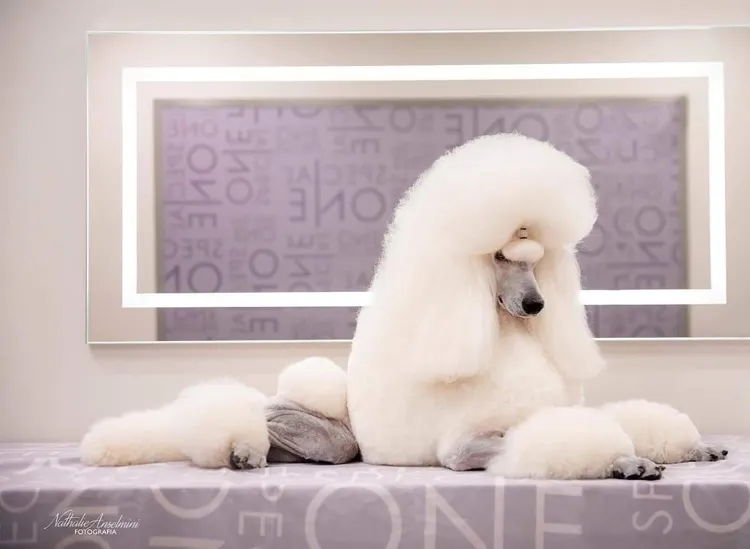
POODLE: dedicated breed profile & GROOMING
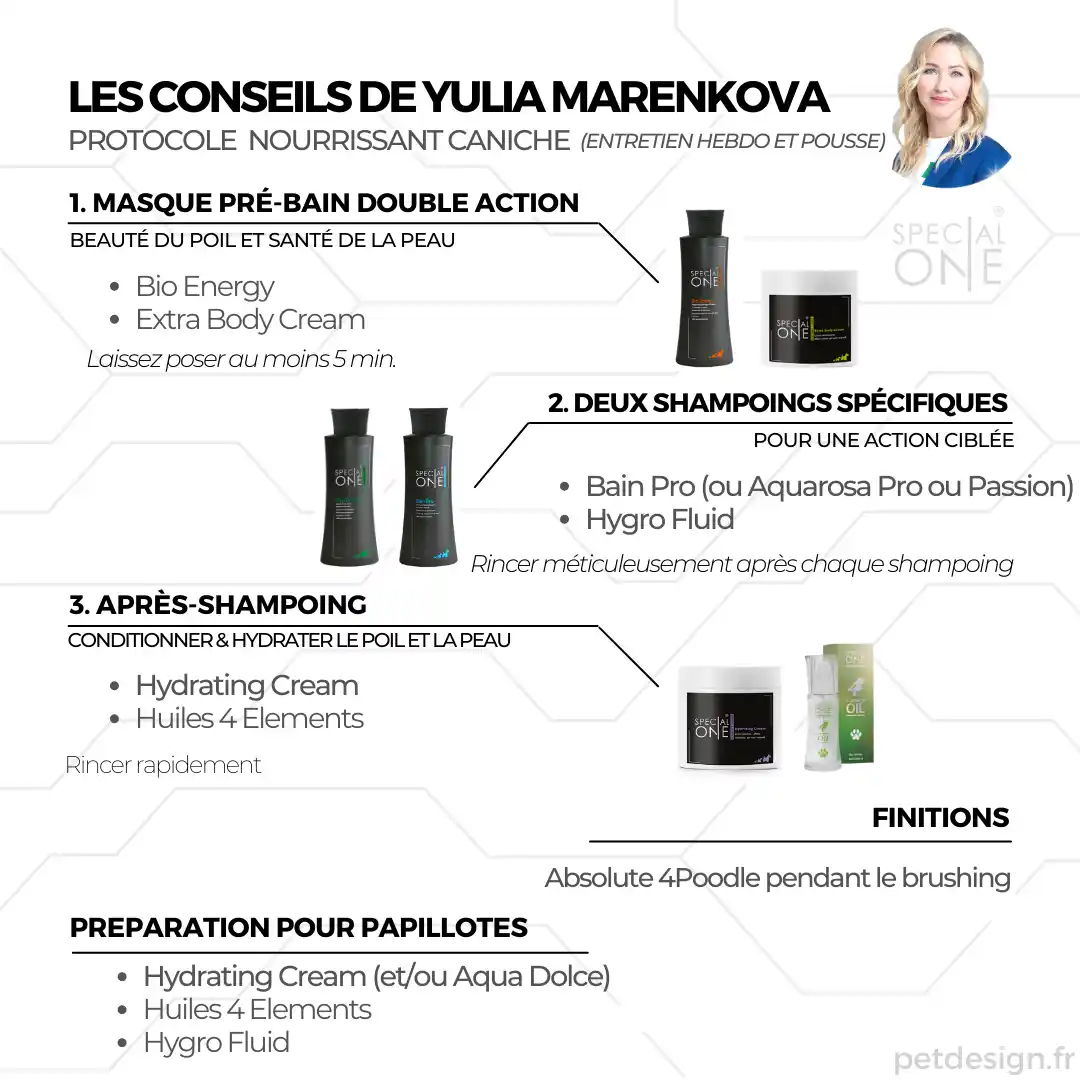
Simple Program & Effective :
AQUAROSA PRO, HYDRATING CREAM & Pink Mix
Full Program & Ambitious: (for maintenance between two exhibitions or two competitions)
Poodle Character
A model of adaptability and sociability. A big softie who always needs a kind word or a cuddle, and can't stand being left alone. A dynamic dog, like a spring in his step, very playful, always full of energy. Mix it all together and you have the perfect companion, calm, affectionate, or energetic depending on his owners' mood and living conditions.
Of course, the picture isn't always so idyllic, because we can't ignore the fact that the poodle is the most common type of dog in France and therefore too often bred haphazardly, both in terms of physical appearance and temperament. It's ultimately a miracle that we don't encounter more unstable and atypical poodles.
The breed is renowned for its remarkable intelligence — the notion of intelligence in dogs being variously understood, let us specify that here it essentially refers to the ability to learn.
This is because it has been selected for this purpose for a very long time. Let us first remember that its ancestor is the Barbet, which was as much a hunter and herder as a water dog, which could only have developed a great adaptability.
The poodle was also a famously clever dog. In short, it inherited a great predisposition to do everything a dog can do. But isn't the most difficult canine profession that of a companion and apartment dog? Leading a blind person, jumping over obstacles
Or through a hoop, nothing could be easier. But having to decide on your own which routine to play each day, a routine learned and perfected without any help, that's something else entirely.
The breed is divided into size varieties suited to different situations. Despite its name, the toy poodle is not a toy. It's not really suitable for a family with children, as it often tends to compensate for its small size with an extra dose of character and willpower. The miniature poodle is easier to live with, and the standard poodle is also a real little athlete, equally at home in an apartment, a house, or the countryside. As for the standard poodle, sometimes called the "royal," it's the poodle in superlative form. Those who prefer a larger breed find in its size a hunting or guard dog all the energetic, affectionate, adaptable, and eager-to-learn qualities that characterize the poodle. And if it hasn't yet become a star, it's due to the grooming requirements that come with its size, nearly 60 cm at the withers, because, of course, the larger the poodle, the more sought-after it becomes.
Poodle Look
Its fur is so dense and long that one cannot simply ignore it. From there, all sorts of creative possibilities are open and have indeed been explored. But let us remember that it remains, first and foremost, a dog—and even a well-built one—whose hunting origins can still be discerned.
While the coat, its colors, grooming, and maintenance often capture attention, it's important to remember that there's a dog underneath. A well-built dog with balanced, elegant lines, but without exaggerated refinement. The harmony of its physique is most evident in the medium and large breeds, whose athleticism is immediately apparent, but small and toy poodles are also built for movement. Regardless of their size, poodles move, but with lightness.
Not only do they move, but they skip and jump: they're like they're on springs. This energetic state isn't just a state of mind and nervous energy, it's physical!
Let's take a closer look at the head, very elegant and refined, but not underdeveloped, with its typical frontal furrow, very visible occipital crest, and barely perceptible stop. The eyes are not round, but slightly slanted, almond-shaped. Eyes that shine like jet, except in brown poodles with amber eyes. The poodle has almost forgotten its hunting past, but its well-developed nose, with wide-open nostrils, and its long, low-set ears betray its true hunting origins. Of course, its very curly and very thick coat, extraordinarily abundant, lends itself to all sorts of styles. Every era has had its fashion. There was a time when the corded poodle was a must-have. Today, it is so rare that one wonders if it will disappear altogether. It was also seen dressed as a Zouave, a Zazou, with macarons, at seaside baths—the bathing suit being renamed "Saint-Tropez" or "Bermuda" in the 60s and 70s—or with a hollandaise sauce. In its German version, it was the Royal Dutch (rzc), characterized by large "boleros".
In 1981, the classic, or continental, cut was joined by the English cut, featuring a topknot on the head and a rear end that is no longer bare, but sculpted into pom-poms. For about ten years, this English cut has evolved into the "puppy" cut, with the front and hind legs wearing trousers. In fact, there is now only one pom-pom, on the tail. Show and street poodles have ultimately evolved in parallel towards greater simplicity—except that show poodles have an exaggerated topknot that rests on a more discreet coat. But with more or less hair, depending on whether it is destined for show or to live a normal life, why shouldn't the poodle remain a dog with balanced proportions, capable of showcasing its vitality and dynamism?
Its fur is so dense and long that one cannot simply ignore it. From there, all sorts of creative possibilities are open and have indeed been explored. But let us remember that it remains, first and foremost, a dog—and even a well-built one—whose hunting origins can still be discerned.
While the coat, its colors, grooming, and maintenance often capture attention, it's important to remember that there's a dog underneath. A well-built dog with balanced, elegant lines, but without exaggerated refinement. The harmony of its physique is most evident in the medium and large breeds, whose athleticism is immediately apparent, but small and toy poodles are also built for movement. Regardless of their size, poodles move, but with lightness.
Not only do they move, but they skip and jump: they're like they're on springs. This energetic state isn't just a state of mind and nervous energy, it's physical!
Let's take a closer look at the head, very elegant and refined, but not underdeveloped, with its typical frontal furrow, very visible occipital crest, and barely perceptible stop. The eyes are not round, but slightly slanted, almond-shaped. Eyes that shine like jet, except in brown poodles with amber eyes. The poodle has almost forgotten its hunting past, but its well-developed nose, with wide-open nostrils, and its long, low-set ears betray its true hunting origins. Of course, its very curly and very thick coat, extraordinarily abundant, lends itself to all sorts of styles. Every era has had its fashion. There was a time when the corded poodle was a must-have. Today, it is so rare that one wonders if it will disappear altogether. It was also seen dressed as a Zouave, a Zazou, with macarons, at seaside baths—the bathing suit being renamed "Saint-Tropez" or "Bermuda" in the 60s and 70s—or with a hollandaise sauce. In its German version, it was the Royal Dutch (rzc), characterized by large "boleros".
In 1981, the English cut was added to the classic, or continental, style, featuring a topknot on the head and a rear end that is no longer bare, but sculpted with pom-poms. For about ten years now, this English cut has evolved into the "puppy" cut, with the hind and forelegs wearing trousers. In fact, instead of pom-poms, there is now only one, on the tail.Show and street poodles have ultimately evolved in parallel towards greater restraint—except that show poodles have an exaggerated topknot that rests on a more discreet coat. But with more or less hair, depending on whether it is destined for show or to live a normal life, why shouldn't the poodle remain a dog with balanced proportions, capable of showcasing its vitality and dynamism?
The beautiful Poodle, a rare breed
How many types of poodles are there? Let's see: standard, medium, miniature, toy... and what about the colors? Wouldn't it be more realistic to say there are two types of poodles: the street poodle and the show poodle? This isn't new, some might say, except that there has never been such a discrepancy between the overall poodle population and the official breed registry statistics. And it's not as if the breed no longer meets public expectations: because these small, sturdy, and athletic companion dogs, adaptable to everyone and everything, are not overpopulated.
While poodles are still frequently seen on the street and in the classifieds, the number of registered poodles has decreased by more than 60% in the space of ten years! Thus, on the one hand, the poodle appears to be the most widespread type of dog in France with a total population reaching or perhaps exceeding 1.5 million, and on the other hand, it is overtaken by the Shih Tzu and the Cavalier King Charles, whose notoriety in the general public is incomparably less than its own.
Yet, at dog shows, nothing of this predicted decline is apparent. Looking at the annual list of international champion titles, one might think the poodle is among the most fashionable breeds currently available. But the world of dog breeding is a world unto itself, and while buyers readily choose from breeds newly discovered and selected by specialists, these specialists rarely take into account the preferences of the majority of dog owners.
However, it appears to be an irreplaceable fact in the current context where an extroverted, easy, robust, unobtrusive, but not tiny, companion dog is sought after, and whose ownership must be accompanied by a minimum of constraints.
From this perspective, the poodle is anything but a "has-been." Grooming isn't really a chore once you've decided to subscribe to a reputable grooming salon. With regular grooming, the poodle requires little maintenance, its appearance always remains acceptable, and it never sheds on the furniture or carpets.
Due to a highly unregulated breeding program where the best is drowned out by the worst, one sometimes gets the impression that the breed has numerous health problems. Conversely, one might be surprised to see so many dogs, with or without papers, that have easily surpassed fifteen years of age without ever having visited the veterinarian for anything other than booster vaccinations.The poodle often ages well, that's a fact. And — this is also a reason for its enormous popularity — it reproduces without any problems.
Something to watch out for: their teeth, especially in smaller dogs, which can build up tartar very quickly, leading to premature gum recession. As for temperament and training, there's nothing to complain about: if treated like a real dog and trained properly, they are very pleasant companions who understand everything immediately. If the poodle didn't exist, it would have to be invented!
History and Origins of the Poodle
His early involvement with dogs was extremely discreet, both in France and in England and Germany. It must be said that attention was focused on hunting dogs, while other working breeds, such as sheepdogs, held some interest. As for companion breeds, often dismissed as lapdogs and ladies' dogs, they were met with condescending disdain. This situation has not disappeared; the ninth group still faces a degree of ostracism.
In France, it seems that the poodle was already a very popular breed of dog in the 19th century, according to numerous contemporary accounts. Official figures are less conclusive. While the first registration in the French Stud Book dates from 1885, three years after the creation of the LOF (which was primarily dedicated to British hunting breeds), it's worth noting that among the first thousand registrations, only nine concern the poodle!
The breed wasn't fundamentally better treated initially in Great Britain, although a Poodle club was established as early as 1876: six entries were recorded in the Kennel Club's second book in 1874 (there were none in its founding year of 1873). However, English breeders quickly took the initiative. Thus, in the 1920s, when French breeding became more structured, it did so using dogs imported from England!
However, in 1936, the Fédération Cynologique Internationale finally looked into the case of the poodle and decided to grant it French nationality, much to the dismay of the German breeders who had established a standard (we can also find traces of it in old French works such as that of the veterinary Doctor Heuillet).
In fact, it must be acknowledged that there is a very ancient type of curly-haired dog that is the ancestor not only of the poodle and the barbet, but also of other breeds that have recently been grouped under the name of water dogs. This type appears to have originated in North Africa and is thought to have primarily reached Europe via the Iberian Peninsula.
This African dog became widespread as both a sheepdog and a water dog, assisting fishermen as well as hunters. But as a small companion dog? In the 15th century, there were depictions of small dogs groomed in lion shapes. The appearance of the racing poodle dates more likely from the 18th century, although its lineage cannot be definitively established.
Today, we can see that the medium poodle, a link between the large and small varieties, which was and remains a French specialty, is marginalized. This is true both for the general public and for English and American breeders who have grouped large and medium poodles into a "standard" category that favors larger dogs. Thus, the standard poodle, once very rare, is now gaining attention in France for its size (officially up to 62 cm) and its long stride. This athletic dog could revive interest in the breed, although the public generally prefers a smaller, low-maintenance dog. Undoubtedly, the poodle needs to reinvent its image. The revival will come from elsewhere, as has been the case since the existence of dog breeding: recognition of grey in 1960, apricot in 1977, English grooming in 1981, and toy in 1984. The official arrival of toy and apricot allowed LOF breeding to prosper until 1990. The poodle is destined for fashion and cannot remain at the forefront by playing exclusively the card of classicism, in black, medium and continental grooming.
Poodle Health
Patellar luxation and other joint problems: As with other common small breeds, this malformation is found in poodles, somewhat like hip dysplasia in larger breeds. Some poodles can also be affected by rupture of the anterior cruciate ligaments. Cases of herniated discs have also been reported. Dental problems: Good oral hygiene is essential to prevent tartar buildup and dental abscesses. Cryptorchidism: This condition primarily affects toy poodles. Progressive retinal atrophy: In the UK, cases of progressive retinal atrophy have been reported in certain lines, a problem that also exists in France.
We hope our advice has helped you in your research and that you now know which path to take to maximize your chances of achieving a stunning result!
Our Shopping List
Here is our selection!
Retrouvez tous les produits Special One selectionnes par nos toiletteurs partenaires.
Voir la gammeContinuez la lecture

The R&D at Special One
Special One: The perfect alchemy of nature, science, and cosmetic innovation at the service of animals ...
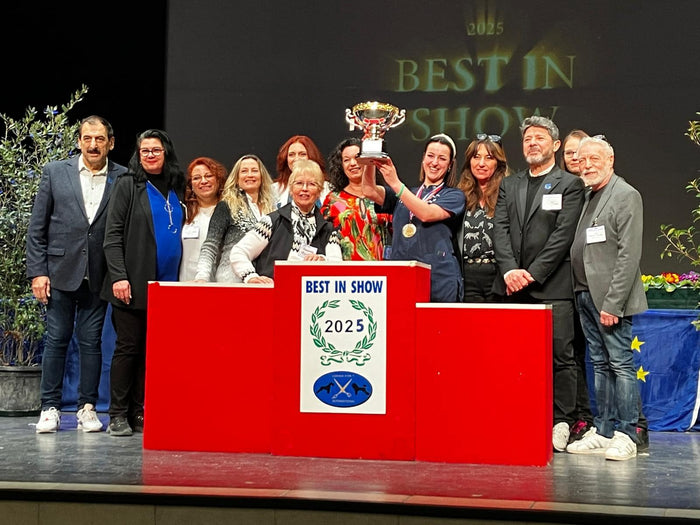
Allison Cabibbo: for the 3rd time in a row, the European Grooming Championship is won by a Special One groomer
We are incredibly proud to announce that our Special One ambassador has just won the prestigious title of E...
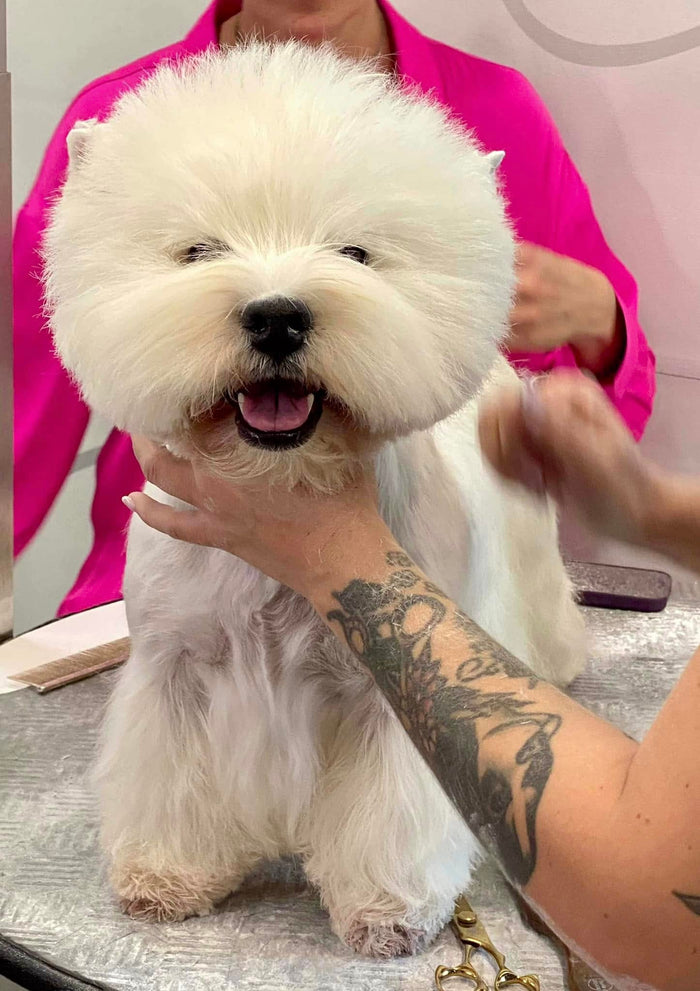
West Highland White Terrier Grooming by Eve Raison & Aurore Guérin with Special One
A big congratulations to these talented groomers, members of the French grooming team, Eve Raison and Auror...
Réagir à cet article