

Dogs: AFGHAN HOUND
Questions about the AFGHAN HOUND? This is the place!
If you can't find what you're looking for, send us a message via the chat.
What is the history of the Afghan Hound?
According to legend, Noah chose it at the time of the Flood to be one of the passengers aboard the famous Ark. The memory of this honor can still be seen in certain specimens, which have a white mark on the head, the “divine mark.”
Nevertheless, despite extensive research conducted by enthusiasts, it is still not currently possible to form even a somewhat precise idea of its age.
Those who have focused on the breed's characteristics tend to think that it originated from a cross between Saluki-type sighthounds and long-haired sheepdogs. They base this in particular on certain morphological features that make the Afghan Hound a rather atypical sighthound, as well as on behavioral characteristics: Prof. C. J. Stelzer, a breed specialist, noted among Afghan Hounds imported directly from their region of origin a tendency to circle around a herd to gather it, an atavistic return to their herding origins! It is possible that some of the first specimens imported to the West had dubious origins, since many others, when faced with livestock, have an all-too-natural tendency to chase it. Even if a herding-dog contribution were accepted, it would be impossible to date it.
Various historical leads have been pursued without much success. One of them was based on the existence of 2,500-year-old frescoes in northwestern Afghanistan, which supposedly depicted Afghan Hounds. A thorough investigation by American specialists concluded that there were no caves in the region mentioned. Rock paintings have indeed been found in the south of the country, but they are much less ancient, and it is very difficult to recognize an Afghan Hound in them.
According to another theory, a 5,000-year-old Egyptian papyrus described an Afghan Hound; it has since turned out to be a description of a baboon, a sacred animal in ancient Egypt.
There is no shortage of ancient evidence of Afghan Hounds, however.
But all of them concern specimens with short or fringed coats. We are ultimately reduced to thinking that the Afghan Hound is an adaptation of these to a very particular environment, with a harsh climate and rugged terrain. What remains completely unknown is the approximate time when this adaptation took place.
Indeed, the Afghan Hound became known to the dog fancy relatively late. The first authentic Afghan Hound arrived in Great Britain in 1907. This was the famous Zardin, who had already caused a sensation at shows in India and was presented to the Queen of England. Unfortunately, he did not produce offspring equal to his qualities, but he served as the model for drafting the first standard, a description of the breed’s characteristics.
Since then, this standard has been revised, but it remains largely inspired by Zardin. Before him, various “Afghan” sighthounds had been presented at English shows; commentators compared them in turn sometimes to Irish Setters, sometimes to bobtails. This shows how little they had to do with the Afghan Hound, other than originating in Afghanistan or neighboring regions.
This Zardin was not an exception. One of the earliest travel accounts of a region near Afghanistan contains a watercolor of an Afghan warrior accompanied by a typical sighthound; it dates from 1809, a century before the breed arrived. This watercolor is the only tangible evidence that the Afghan Hound did not have to wait for the dog fancy to come into existence.
It did not become established in Europe until the 1920s, when several officers of the Indian Army brought back Afghan Hounds as souvenirs of their service in the East—Afghanistan having become independent in 1919. In 1927, the English Kennel Club registered 20 Afghans; the following year, already 65. Among the pioneering countries were the Netherlands and Germany (from 1927), the Scandinavian countries and the United States (after 1930). France entered the arena in 1936.
But until the 1960s, the Afghan Hound was known only to a small circle of dog enthusiasts. Given its appearance, it was bound to achieve wider popularity. It must be said that despite the extraordinary diversity of the canine species, it is ultimately rare to find breeds as radically distinct from all others as the Afghan Hound was in its day—or the Shar-Pei in recent years.
We have become accustomed to its silhouette, which nevertheless remains just as original today as it was yesterday. It even seems likely to become more original still: it is very rare, if not unthinkable, for a dog-breeding selection program to aim at making a breed’s appearance commonplace. One need only look at a few photographs dating from the 1960s, 1970s, and even 1980s to see the Afghan Hound’s evolution over the past thirty years immediately.
Today’s Afghan Hound has a coat that is incredibly developed in length and thickness, with a diversity of colors that probably has few equivalents among dog breeds. American breeders have made their mark and unquestionably hold the leading position in Afghan Hound selection.
The contrast between aerodynamic lines and the coat of a luxury dog is becoming increasingly striking. It must be said that an abundance of hair does not exactly promote aerodynamic efficiency: for it to become a true racer again, the Afghan Hound would have to be shaved periodically.
What is the temperament of the Afghan Hound?
The temperament has evolved just as much as the appearance. The Afghan Hound was originally a spirited hunter; in the deserts, it pursued gazelles and hares; in the mountains, its preferred prey included mouflon, wild goats, and even the snow leopard. Certainly smaller than the leopard of tropical regions, but there is no doubt that this sighthound had a truly strong character. The breed’s first British promoters may, moreover, have exaggerated its ferocity. Some specimens brought to France in the early 1970s, when the Afghan Hound was still little known, proved to be unyielding guard dogs and even more—highly aggressive protection dogs. But fundamentally, it is a show animal, and it is not an exaggeration to say that dog shows played a major role in selecting for a sociable and patient temperament. Clearly, an unmanageable animal that is unwilling to be groomed every day or examined at length by a judge, and that cannot be kept around other dogs or the public, cannot be selected for breeding.
Today's Afghan has become a pleasant companion, quiet and calm, doing his best to make his impressive stature unobtrusive in an apartment. He loves comfort and soft cushions, provided he also has enough opportunity to let off steam. But one must never lose sight of the fact that a beautiful specimen cannot be maintained without living in the home. An Afghan that lives in the garden will never develop the sumptuous coat that is the breed's defining feature.
He is sometimes considered disdainful or aloof. It is true that he is often rather indifferent toward strangers, ignoring their attempts to engage him. And like other Asian-type sighthounds, he is not necessarily very demonstrative in expressing affection. At heart, he remains a freedom-loving aristocrat. But make no mistake: he is deeply attached to his owners. In fact, many Afghans are much less wary, and although you should not expect them to jump on visitors seeking affection, they are happy to welcome them.
Intelligent, observant, and possessing an excellent memory, he is easy to train and is not particularly stubborn. He adapts anywhere—in the city, in a house, or in the countryside. If you do not want a show dog, he can become a great athlete, enjoying racing at a greyhound track or, better still, lure coursing, which is more in keeping with his ancestral instincts. If the environment is conducive, those instincts may resurface: when his hunting ancestry reawakens, he may become an escape artist.
How to groom your Afghan Hound quickly and effectively?
Anyone acquiring an Afghan cannot ignore the demands of caring for its coat. If they have only ever owned short-haired dogs, they should not get an Afghan without careful consideration—and without first attending a complete grooming session. It is no coincidence that a number of Afghan breeders and specialists are groomers; their passion for this exceptional dog often led them to take up the profession.
Detangling and brushing are frequent and meticulous, and even bathing is necessary if you want a spectacular-looking dog. You should know that the strands of show specimens are regularly oiled.
Its elegance cannot tolerate the SLIGHTEST NEGLECT: FOR THIS DOG, GROOMING IS BEST DONE DAILY.
For bathing, it all depends on the coat, as some get dirtier than others, the frequency of the dog's outings ... and your own standards. Depending on these factors, bathe the dog every five days to once a month. To dry it, avoid rubbing it, as this would felt the fur.
Here are my grooming tips for spectacular results:
✔️ Shampoo: Aquarosa Pro
✔️ Conditioner: Aqua Dolce
✔️ Finishing/brushing/detangling spray: Mix pink
What are the colors of the Afghan Hound?
As for colors, the standard tersely states that “all colors are allowed.” One should always refer to the section describing the desirable shades of the nose and eyes to get a more precise idea of this liberal policy. “All colors” generally does not mean “any coat.” In the case of the Afghan Hound, a liver-colored nose and golden eyes are permitted: this rules out piebald coats, known as harlequin or merle, which are often accompanied by blue eyes. On the other hand, one cannot tell from this that blue or grizzled coats are accepted: they go with a slate-colored nose, meaning one that is not quite black. Ultimately, although some coats are not permitted (merle), poorly regarded (with large white patches), or seemingly absent (brown), the range is truly immense and often exquisite: gold is more common than silver, platinum, or ivory. As for “domino,” one should not think that it refers to a checkered coat or one with black spots. Tanjores Domino was the name of a famous Finnish stud who had an exceptional career in the USA: he had a previously unseen coat, a cream color highlighted by a few blue-gray charcoal markings, with a brown nose.
Our Shopping List for the AFGHAN HOUND
Here is a selection of the products we offer
Passez a la pratique
Retrouvez tous les produits Special One selectionnes par nos toiletteurs partenaires.
Voir la gammeA lire ensuite
Continuez la lecture
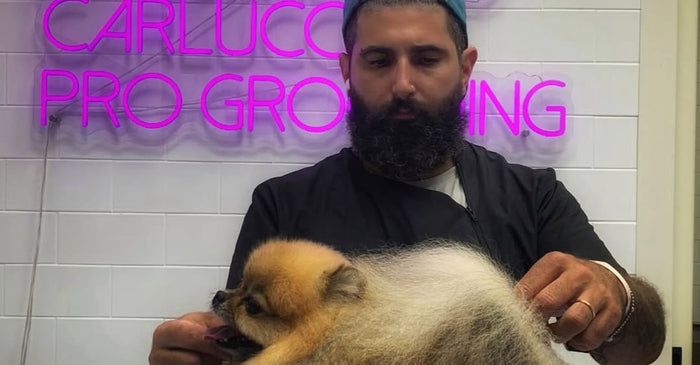
1 mars 2025
Training in Belgium by Massimiliano Carluccio & Special One France on Petdesign.fr
✨ Perfect your grooming with Massimiliano Carluccio! ✨ Do you dream of excelling in the art of dog groomin...
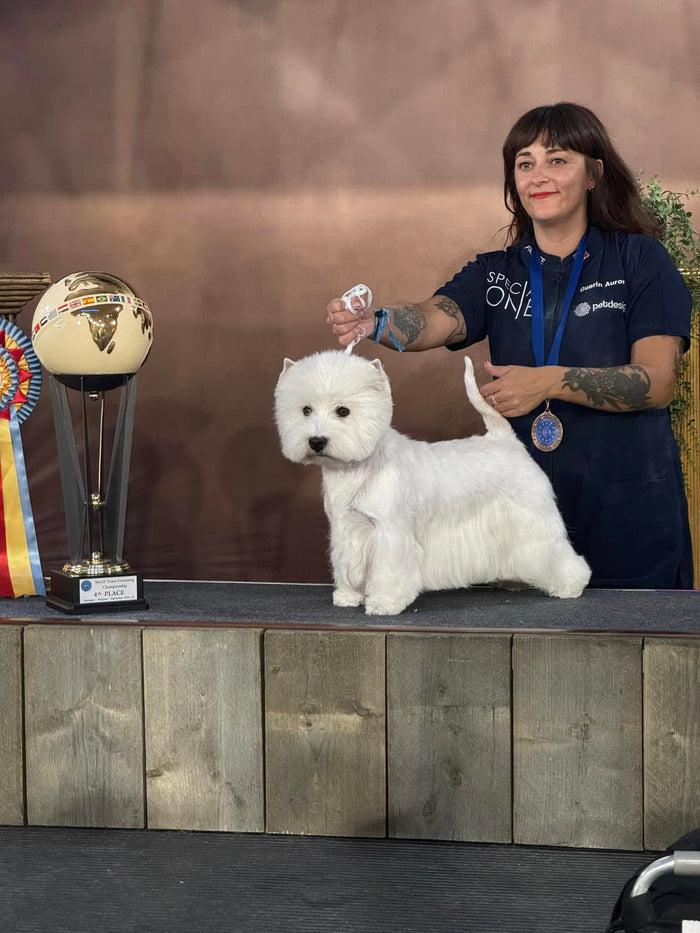
31 janvier 2025
Aurore Guérin's training in Belgium & Special One France on Petdesign.fr
Perfect your technique with Aurore Guerin, a grooming champion! Dog grooming enthusiasts, this training da...
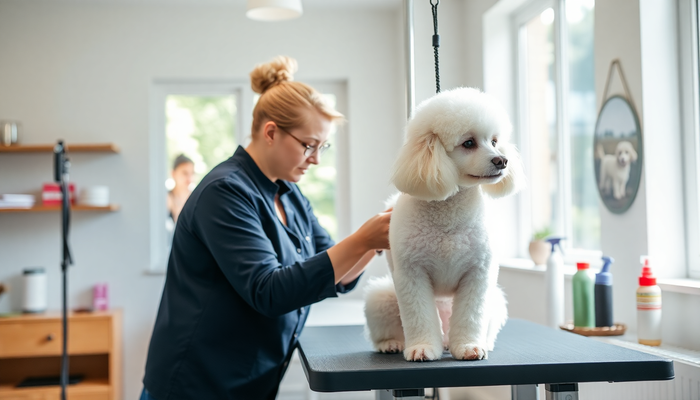
14 janvier 2025
Perfect Poodle Grooming: Expert Advice for an Impeccable Coat
Do you own a poodle and are looking for the best grooming tips? You've come to the right place! In this art...
Réagir à cet article