


Dogs: Husky
Do you have questions about the Siberian Husky? You’re in the right place!
If you can’t find what you’re looking for, send us a message in the chat.
What is the history of the Siberian Husky?
It rose to fame in 1909, when a fur trader entered a team of Huskies in a race. They finished third, to everyone’s surprise, despite having only dogs of little substance. From that point on, many dogs were imported from Siberia. Breeding kennels sprang up everywhere.
And as good news never comes alone, in 1925, a team of Huskies saved the city of Nome from a diphtheria epidemic. Given the weather conditions, only sleds could deliver the serum to its destination. More than a thousand kilometers were covered in a violent storm.
Thus, the Chukchi dog also won over the North American continent. The last purebred dogs from Siberia were acquired in 1930. Admirers of these dogs quickly understood that, to preserve their original qualities, it was necessary to establish a standard. In 1930, the American Kennel Club recognized the breed. The standard was drafted in 1932. Seven years later, Canada also recognized this standard, but it was not until 1966 that the Fédération Cynologique Internationale formally recognized the breed’s identity. Until then, only Switzerland and Norway had welcomed the breed to Europe.
It was in 1972 that the first Siberian Husky was registered in the French Book of Origins: Kolyam du Patis du Roy. The first French Champion of Conformity to the Standard was Prince Mitya in 1974. That same year, B’amarok became the first French working champion.
Unfortunately, the Siberian Husky is the very embodiment of a dog “ruined” by the fashion phenomenon. Our northern breed has always been a pack dog, selected solely for work. Unfortunately, the success it enjoyed in the 1980s and 1990s revealed the Siberian Husky in a different light.
Maladjustment Period
First of all, there is the fashion phenomenon: it is clear that whenever a dog breed is thrust into the spotlight and attracts a certain number of breeders or people claiming to be breeders, media pressure becomes strong enough for demand to exceed supply. As a result, all kinds of dogs are produced, more or less close to the standard. It is acknowledged that their behavior suffers as well. Unfortunately, if a prospective buyer does not want to turn to a breeder registered with the Société Centrale Canine—that is, one producing only L.O.F.-registered dogs—they may be in for some unpleasant surprises. Not long ago, it was possible to find paperless Siberians in pet shops costing more than those bought from a breeder, with the unfortunate habit of becoming veterinarians’ favorite clients. As for temperament, it is clear that market pressure did not select balanced individuals, even though these dogs were being diverted from their original purpose. Selected for their abilities and endurance at work, could they adapt to apartments without harmful consequences? The Husky is the perfect example of future owners’ ignorance when they choose a breed for its appearance before any other consideration, including behavior. It is therefore no surprise to see it at the top of the abandonment charts in the Île-de-France region. Abandonments are often due to its tendency to run away and a certain aggressiveness. The Chukchi kept only the most energetic and alert dogs. They all lived in packs. These criteria were qualities that breeders continued to develop until the 1990s. It is therefore impossible to adopt a Husky in the city unless its owner is a committed athlete.
What is the Husky’s temperament?
The Husky likes living in a pack. It is a state of mind. The pack, a highly hierarchical little society, has its laws and codes, which are passed down among initiates—that is, among dogs. As the owner, you can always imagine that you are the super-pack leader, but do not lose sight of the fact that you should intervene only to prevent serious fights, without paying attention to minor squabbles.
“The true pack,” explains Christian Leneuf, “is not a group of dogs. People buy four Huskies and think they are forming a pack. But that does not always work, because a pack naturally forms, in most cases, among dogs from the same family.” Huskies have a very strict sense of family: “The adults begin teaching their young their place in the hierarchy at around five months. They would never bite one of the puppies in their pack. However, I would not put a puppy from outside the pack in the middle of my Huskies; they would kill it.” That applies to dogs, because the Husky is a true nanny with human children, whether they belong to its family or not.
When you have only two dogs, you mainly observe the husky’s dominance instinct, which varies depending on the circumstances. “If you have two that are neither dominant, they live well together,” our interviewee continues. “If only one has this trait, the other submits. But if you have two dominant dogs, it is hell! You need to think about this when buying. A good breeder immediately knows whether there is a dominant puppy in a litter of two-month-old youngsters: it is the one that knocks everyone else to the ground and wants its food all to itself.”
Let us remember that the husky, which is meant to live in a group, languishes when it is an “only child.” A companion, even of another breed, with whom it can “speak dog,” is one of the keys to its happiness.
How to groom your Husky quickly and effectively?
Here are my grooming tips for spectacular results:
✔️ Shampoo: Aquarosa Pro
✔️ Conditioner: Aqua Dolce
✔️ Finishing/brushing/detangling spray: Mix Pink
Is the Siberian Husky a runaway?
A husky is trained like any other dog ... Only the results are different.
Given its great sensitivity, it should be taught good manners gently, with good humor and kindness.
This is not a dog that stands at attention; it never obeys blindly. Do not hope to establish your authority—which will be limited anyway—by using force. “Putting pressure on a husky achieves nothing good,” explains Ms. Bédarride. “It is a dog that comes to you because it loves you, not to obey.”
In harness, things are different, because the husky takes pride in a job well done and obeys the commands of the musher, its handler. Nevertheless, in everyday life, our friend is far from disciplined. Saying that the husky is independent is almost a pleonasm. When something interests it more than the command you give it, guess which one it chooses! And when, in the great outdoors, the appetizing image of a tender >- lamb crosses its mind, avoiding an escape is difficult, especially if it has the opportunity to join a pack.
The husky is a very sensitive, unpredictable animal that is never servile. “It is a primitive dog, and it is not 100% reliable,” people say. That is true. But that does not mean it can be dangerous. It is an extremely affectionate and friendly animal toward humans. As a guard dog, it is frankly useless; thieves could ransack your house from top to bottom and it would see nothing wrong with it! If you need to stay vigilant with a husky, it is because it is possessed by the demons of hunting and escaping. It is therefore necessary to surround your property with a sturdy fence, reinforced with concrete at its base. This is vital advice if you do not want to risk your companion adding to the list of those caught red-handed in the chicken coop and shot by farmers.
Running at their own pace
As fast as it is enduring, the husky is equally suited to speed events and medium- or long-distance races. Its fans also lament that it was dethroned by the very fast Alaskan husky (a breed not recognized by the FCI) in the Iditarod. This 2,000-kilometer race, which counts toward the world championship, is perfectly suited to the Siberian Husky...
At the national level, the Fédération française de Pulka et Traîneau à Chiens (FFPTC) organizes numerous events in winter throughout our mountainous regions. To register, you must belong to a club affiliated with the Federation and apply for a license. There is no need to be afraid to take the plunge, because “everyone is welcome,” declares Colette Bédarride, president of the FFPTC. In races, dogs can go at their own pace. It is like the New York Marathon: most participants are not aiming for the podium. They run for pleasure.”
In a somewhat different vein, you can also go hiking, without timing yourself, but still experience wonderful moments. Training for young athletes begins once their growth is complete. It is scheduled according to the type of competition being considered and must be gradual and consistent. It is fascinating work, but it cannot be improvised: advice gathered from regional clubs is essential for newcomers. Sled races: a wonderful but sometimes ruthless world... We have mentioned dogs that “disappear” when they are no longer performing well enough, but there is another problem: “For 15 years, the pleasure mushers who discovered this sport through—and for—their dogs felt has, for some, turned into a greedy competition, forgetting that performance is measured not only in seconds and leg length, but in harmony and the joy of running,” denounce Catherine and Michel Leroux. The obsession with shaving seconds off times has indeed led to the emergence of dogs—often foreign and without certification—that are far removed from the breed type. Fortunately, the FFPTC is fighting these excesses, with the very active support of the Siberian Husky Club of France. As for shows, let us hope that the fashion for the “cross-dressed,” talc-covered husky, with fur puffed up like a pom-pom and eyes made up with kohl (where do they get all this from?), will pass.
France has a population of at least 40,000 dogs, whose overall quality is indisputable. And the Club watches over its protégés jealously. In particular, in 1991 it introduced a working certificate, mandatory for approval of the French Conformity to Standard championship title. This is an important measure, as it allows the husky to remain what it should be: a “magnificent working dog.”
Our Shopping List for the Siberian Husky
Here is a selection of the products we offer
Passez a la pratique
Retrouvez tous les produits Special One selectionnes par nos toiletteurs partenaires.
Voir la gammeA lire ensuite
Continuez la lecture
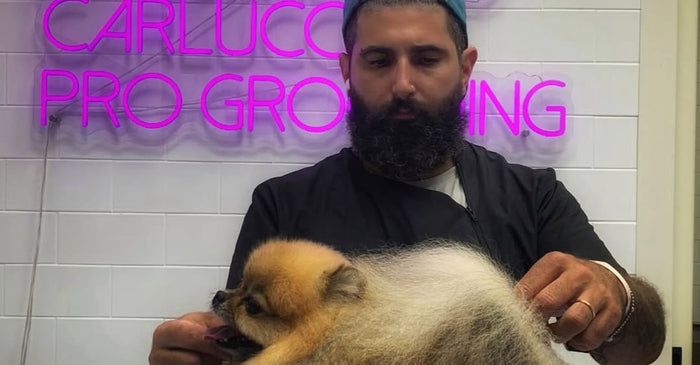
1 mars 2025
Training in Belgium by Massimiliano Carluccio & Special One France on Petdesign.fr
✨ Perfect your grooming with Massimiliano Carluccio! ✨ Do you dream of excelling in the art of dog groomin...
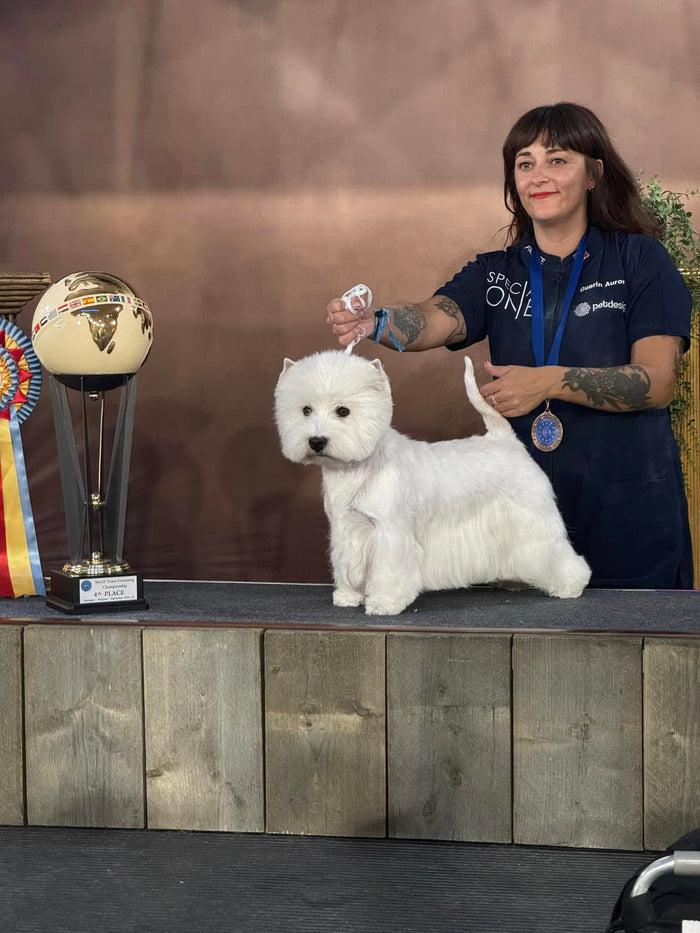
31 janvier 2025
Aurore Guérin's training in Belgium & Special One France on Petdesign.fr
Perfect your technique with Aurore Guerin, a grooming champion! Dog grooming enthusiasts, this training da...
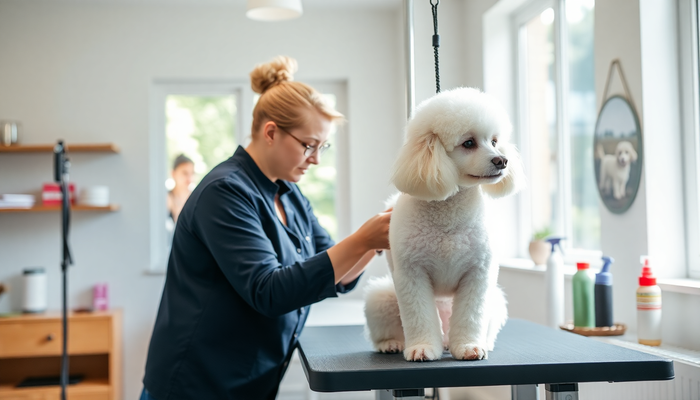
14 janvier 2025
Perfect Poodle Grooming: Expert Advice for an Impeccable Coat
Do you own a poodle and are looking for the best grooming tips? You've come to the right place! In this art...
Réagir à cet article