

Afghan Hound

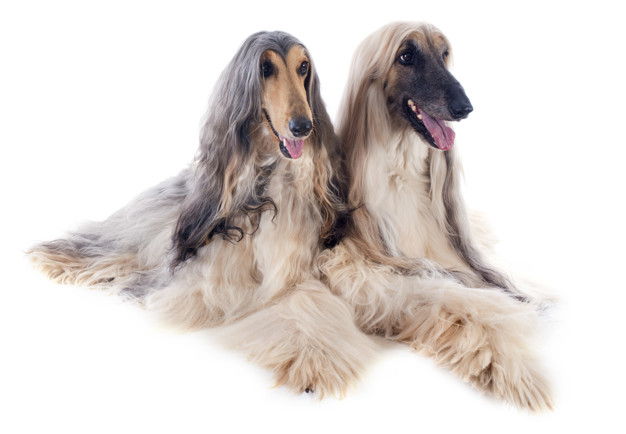
AFGHAN GREYHOUND: dedicated breed profile & GROOMING
Simple Program & Effective :
AQUAROSA PRO, HYDRATING CREAM & AQUA BEAUTY
Full Program & Ambitious :
BIO ENERGY, 4 ELEMENT OILS
AQUAROSA PRO
AQUA DOLCE, HYDRATING CREAM, BOMBASTIC
AQUA BEAUTY, ABSOLUTE 4POODLE
AFGHAN GREYHOUND: a daily passion
No longer having to chase the mouflon or the snow leopard, it has become a fabulous show animal.
It combines the silky texture and length of a Yorkshire Terrier's coat with the thickness of an Old English Sheepdog's. This overdeveloped coat leaves the head and tail untouched, two distinctive features of its sighthound nature. The thin tail curls into a ring, clearly visible when the dog is interested or excited.
IT IS STILL ONE OF THE MOST ORIGINAL BREEDS IN CREATION: IT COMBINES THE LINES OF GREYHOUNDS WITH ONE OF THE MOST SUMPTUOUS FURS, BY ITS LENGTH, THICKNESS AND THE DIVERSITY OF ITS COLORS.
The head is obviously narrow and long, but the jaws retain a certain power, the skull a slight roundness.Its proportions are perhaps slightly less streamlined than those of other, more elegant sighthounds. The skull has a pronounced occipital point, but the topknot, the tuft of long hair on the crown of the head, obscures this feature. These tufts blend into the very long fringes of the ears, which conceal a typical trait it shares with other Oriental sighthounds: low-set ears carried flat against the back of the cheeks. Like them, it differs from European sighthounds, whose ears are set back against the neck, revealing the inside—the English refer to them as "rose-shaped" ears, as they are known to be exceptional gardeners.
It's difficult to describe the proportions of the body and limbs, as they are completely obscured by the fur. You have to shave it to see that it's square-shaped, with distinctly prominent hips and a short, muscular loin, giving a certain impression of compact solidity. Again, everything is relative and only truly meaningful when compared to close relatives like the slender Saluki. Some Anglo-Saxon judges, however, insist on verifying this robustness, checking, for example, the width between the points of the hips (the width of a man's hand) and even pressing down on them.
The Afghan Hound is a large breed dog: males can reach up to 75 cm (28 in), females 70 cm (28 in), with the lower limits being 68 cm (24 in) and 61 cm (24 in) respectively. These measurements are based on the points used for breed standard approval, as the standard measurements are expressed in inches, which corresponds to 68.58 cm (24 in) and 73.66 cm (28 in), for example, for males. These hundredths of a centimeter are quite remarkable, considering the thickness of their coat!
The colors of Afghanistan
Regarding coat colors, the standard laconically states that "all colors are permitted." One must always refer to the section describing desirable nose and eye shades for a more precise understanding of this liberal approach. "All colors" generally does not mean "any coat." In the case of the Afghan Hound, a liver-colored nose and golden eyes are acceptable: this excludes mottled coats, known as harlequin or merle, which are often accompanied by blue eyes. On the other hand, it's not immediately obvious that blue or grizzled coats are accepted: they go hand in hand with a slate-colored nose, meaning not quite black. Ultimately, although some coat colors are not permitted (merle), are not highly valued (large white patches), or are simply absent (brown), the range is truly vast, often precious: gold is more common than silver, platinum, or ivory. As for the "domino" coat, it should not be thought of as a checkered or black-spotted coat. Tanjores Domino was the name of a famous Finnish stallion who had an exceptional career in the USA: he had a coat that was unprecedented at the time, a cream color highlighted with some grey-blue charcoal markings, and a brown nose.
What is the temperament of the Afghan Hound?
The Afghan Hound's temperament has evolved as much as its appearance. Originally, it was a spirited hunter; in the deserts, it pursued gazelle and hare; in the mountains, its preferred prey included mouflon, wild goat, and even snow leopard. While certainly smaller than the leopard of tropical regions, there's no doubt this sighthound had a truly fiery character.The early British promoters of the breed may well have exaggerated its ferocity. Some specimens brought to France in the early 1970s, when the Afghan Hound was still relatively unknown, proved to be formidable guard dogs, even more so, aggressive defense dogs. But fundamentally, it is a show dog, and it is no exaggeration to say that dog shows have played a major role in selecting for a sociable and patient temperament. Clearly, an unmanageable animal that doesn't readily allow itself to be groomed daily or examined at leisure by a judge, and that cannot be allowed to socialize with other dogs or the public, cannot be kept for breeding.
The modern Afghan Hound has become a pleasant companion, quiet and calm, doing its best to disguise its large size in an apartment. It loves comfort and soft cushions, provided it also has ample opportunity to exercise. However, it's crucial to remember that a truly beautiful animal cannot thrive without living indoors. An Afghan Hound living in the garden will never develop the magnificent coat that is the defining characteristic of the breed.
He can sometimes be perceived as disdainful or cold. It's true that he often appears indifferent to strangers, not responding to their advances. And, like other Asian-type sighthounds, he isn't necessarily very demonstrative in his displays of affection. He remains, at heart, a free-spirited gentleman. But make no mistake, he is deeply attached to his owners. In fact, many Afghan Hounds are far less wary, and while you shouldn't expect them to jump on visitors seeking affection, they readily give them a warm welcome.
Intelligent, observant, and possessing a great memory, he is easy to train and not particularly stubborn. He adapts well to any environment, whether in the city, a suburban house, or the countryside. If you don't want him to be a show dog, you can train him to be a great athlete, loving greyhound racing or, even better, lure coursing, which is more in line with his ancestral instincts. These instincts, if the environment is right, can resurface: by rediscovering his hunting instincts, he might become a runaway.
Afghan Hound: the vet's point
Beneath its luxurious coat lies a balanced and healthy animal, robust and active. It can live at least 13 or 14 years while maintaining its vitality. Like many sighthounds, it is very rarely ill. Curiously, it can sometimes suffer from dysplasia, which is rather atypical among members of Group 10.
Other problems can affect him, particularly eye issues, but these are very rare. It should be noted that some Afghan Hounds are highly sensitive to anesthetics, but this is now well known to veterinarians. Overall, he enjoys excellent health, which his elegant appearance might not necessarily suggest.
Conclusion
This magnificent animal is therefore reserved for an elite: not snobs, but passionate enthusiasts completely devoted to the breed. And don't imagine that in their hands, the Afghan Hound becomes a toy subject to their every whim. On the contrary, it is placed on a pedestal—the grooming table. The love for the Afghan Hound is a bit like a religion devoted to beauty, which cannot be understood if one has never entered one of its temples!
HIS FAMILY
It belongs to the large family of Oriental sighthounds, whose best-known representatives are the Sloughi and the Saluki. They are thus distinguished from European sighthounds, particularly the Greyhound, whose morphology has adapted to racing on a greyhound track. Oriental sighthounds are less fast but better suited to chasing over varied, even rugged, terrain. They also have less muscular build, which allows them greater endurance. The Afghan Hound is the one that deviates most from the racing sighthound type, not only in its coat but especially in its morphology. It has other cousins, like itself adapted to difficult terrain at high altitudes. These include the Kyrgyz sighthound, which was recognized by Soviet dog enthusiasts under the name Taigan; there was also formerly the Banjara, a variety of Indian sighthound.
We hope our advice has helped you in your research and that you now know which path to take to maximize your chances of achieving a stunning result!
Our Shopping List
Here is our selection!
Retrouvez tous les produits Special One selectionnes par nos toiletteurs partenaires.
Voir la gammeContinuez la lecture

The R&D at Special One
Special One: The perfect alchemy of nature, science, and cosmetic innovation at the service of animals ...
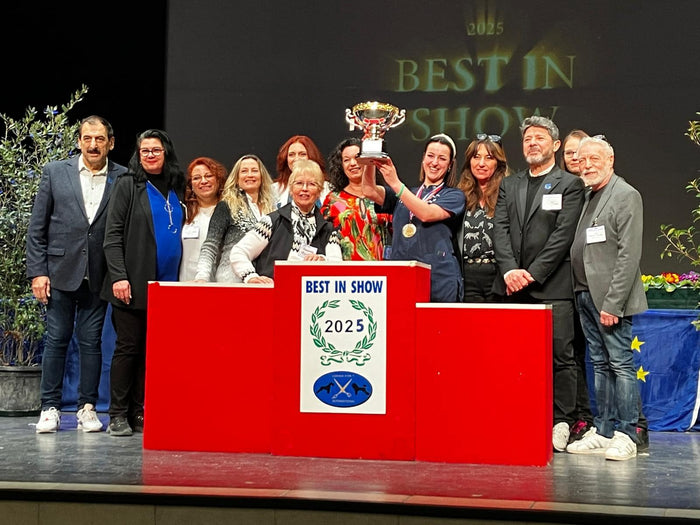
Allison Cabibbo: for the 3rd time in a row, the European Grooming Championship is won by a Special One groomer
We are incredibly proud to announce that our Special One ambassador has just won the prestigious title of E...
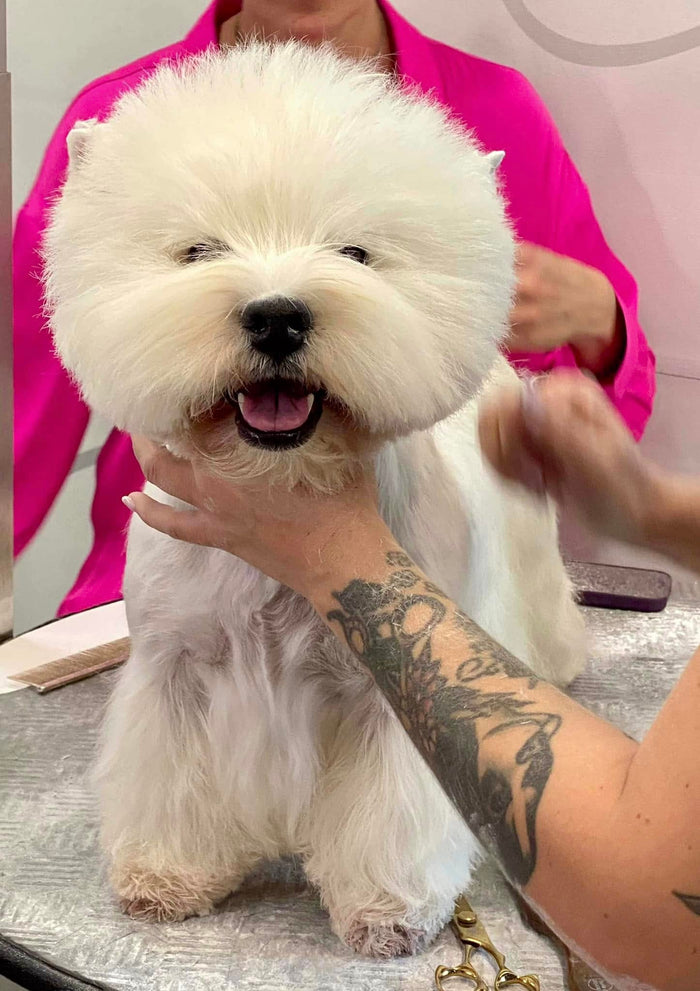
West Highland White Terrier Grooming by Eve Raison & Aurore Guérin with Special One
A big congratulations to these talented groomers, members of the French grooming team, Eve Raison and Auror...
Réagir à cet article