


Dogs: Spitz
Any questions? This is the place!
If you can’t find what you’re looking for, send us a message via the chat.
The Spitz is quite simply, if you’ll pardon the expression, the most direct representative of the oldest dogs domesticated in Europe. We can even be more specific: the oldest companion dogs, since they have never had any other function.
By constantly saying that the canine species diversified over the course of millennia and centuries, we come to forget that dogs closely related to the first domesticated dog still exist. Of course, small Spitz dogs have been miniaturized, their silhouette standardized, and their coat made more luxurious. But it would take considerable bad faith not to see at first glance their close relationship with primitive Spitz dogs—if only we could visualize the famous “bog dogs,” whose remains attest to the presence of the canine species alongside Europeans in the Stone Age.
The Spitz is typically European. It is traditionally known in Germany, the Netherlands, Belgium, Poland, and the Baltic countries, but also in France, particularly in Alsace. The word “loulou” bears witness, if proof were needed, to the traditional presence of this type of dog in
our country. Italy played an early role in miniaturizing this type of dog with its Volpino, its “little fox.” And yet the fame of this type of dog comes from one of the few countries where its ancient presence has not been established: England. English breeders, led by Queen Victoria, selected Italian dogs, especially those from Florence, while nevertheless giving them the name “Pomeranian,” after the province of Pomerania, which was Prussian at the end of the 19th century. The German breed club dates back to 1899 and has claimed the breed’s Germanic heritage ever since. This request was finally accepted by the Fédération Cynologique Internationale in 1960. Examining registrations in studbooks gives a rough idea of current leadership: more than 1,000 births in Great Britain, 600 in Italy, just under that number in France, fewer than 400 in Germany, and 35,000 to 40,000 in the United States. Quantity is not quality, of course. Small Spitz dogs are not currently “trendy.” All the more reason to set your heart on one of them: it is more likely to turn out very beautiful and very affectionate, that’s for sure!
What is the personality of the Pomeranian?
Small Spitzes are probably, along with Poodles, the dogs most often seen on the stages of
music halls and circus rings. Hence its well-established and justified reputation for intelligence and trainability, in contradiction with the labels attributed to them: aggressive and yappy. Unless this reflects a certain reality—that some owners do not take sufficient care of their dogs. And the Spitz needs attention, which is easily understandable: it has been exclusively in the service of humans for thousands of years. No one is better able to show such attentiveness and thoughtfulness. Do you want to train it? It will respond to all your commands without hesitation. Would you rather see it play the role of a confidant? Nothing could be easier. Do you want it to be more active, even athletic? All the better—it loves that.
Ultimately, this is a model of adaptability without being devoid of character. It has its pride and knows how to play the king of the land when out for a walk. It quickly realizes that its luxurious coat attracts admiring glances. Nevertheless, it remains a normal, well-built dog, without any exaggeration, and is therefore capable of great activity, as well as having a balanced temperament.
As we have already emphasized, the breed comes in three varieties, ranging in height from 15 to 36 cm. This is important, and it is not so much a question of centimeters as of character. A dog measuring less than 20 cm at the withers is more sensitive and more prone to nervousness; it is usually carried in its owner’s arms, hence its inclination toward exclusivity. One measuring over 30 cm is a true little athlete, very comfortable in the garden. A division among owners therefore makes perfect sense: the medium-sized ones for families with children, and the toy ones preferably for people living alone—not only older people!
How to groom your Pomeranian quickly and effectively?
Our Shopping List for Pomeranians
Here is a selection of the products we offer
Retrouvez tous les produits Special One selectionnes par nos toiletteurs partenaires.
Voir la gammeContinuez la lecture
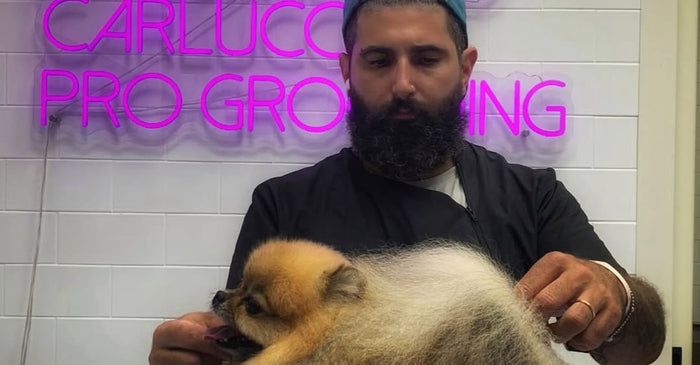
Training in Belgium by Massimiliano Carluccio & Special One France on Petdesign.fr
✨ Perfect your grooming with Massimiliano Carluccio! ✨ Do you dream of excelling in the art of dog groomin...
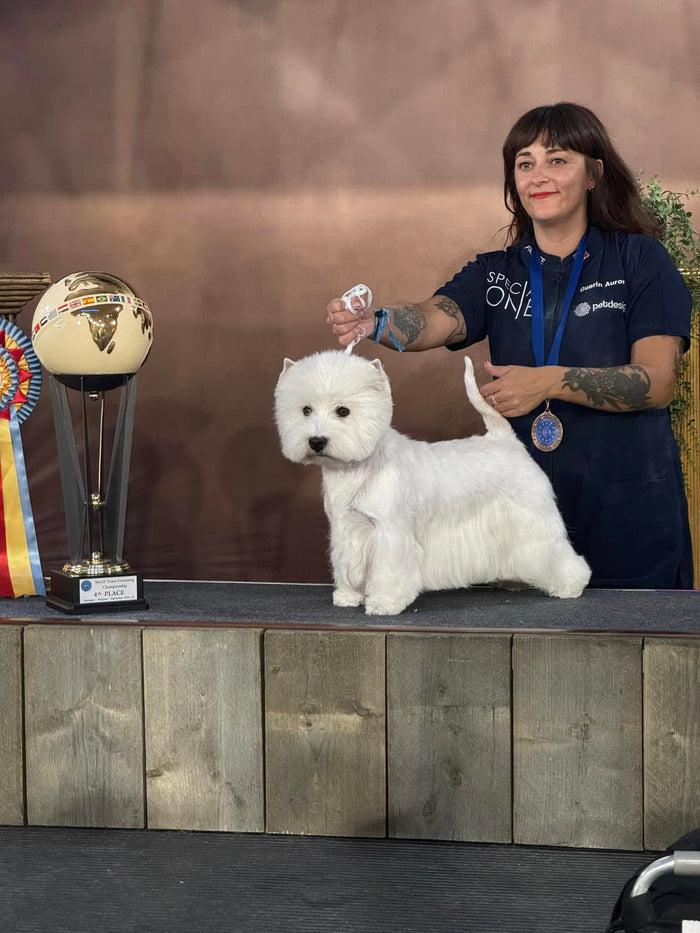
Aurore Guérin's training in Belgium & Special One France on Petdesign.fr
Perfect your technique with Aurore Guerin, a grooming champion! Dog grooming enthusiasts, this training da...
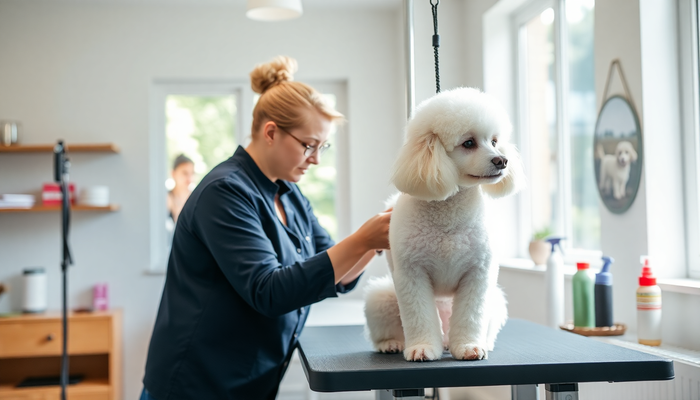
Perfect Poodle Grooming: Expert Advice for an Impeccable Coat
Do you own a poodle and are looking for the best grooming tips? You've come to the right place! In this art...
Réagir à cet article