


Dogs: Rottweiler
Questions about the Rottweiler? This is the place!
If you can’t find what you’re looking for, send us a message via the chat.
It is a molossoid.....
This word, unknown to the public until quite recently, is on everyone’s lips. Even Georges Sarre used it when he wanted to specify the type of dogs likely to prove dangerous. More precisely, it is a mastiff-type molosser. Molossers, after being long forgotten or even reviled, have made a strong comeback. And the Rott is their herald.
The Rott is descended from the mastiffs of antiquity, more specifically those that guarded the cattle of the Roman legions. The city of Rottweil, in southern Germany, was a renowned livestock market for centuries. It was also home to some of the most highly regarded butchers’ dogs. One might have expected these dogs to serve as the foundation for one of the first German breeds, with the emergence of official German dog breeding at the end of the last century.
That was not the case: the Rottweiler was then on the verge of extinction. Fortunately, a few enthusiasts became concerned about its fate and defined the breed’s characteristics in a standard in 1901. Having formed an association in 1907, they opened the stud book the following year. Modern selection dates from the following decade; the Rottweiler began to thrive in its homeland during the 1920s.
Although it has been recognized in the United States since 1935, the English Kennel Club would not do the same until 1966. In France, the first dog was not registered in the French Stud Book until 1970. The Rott suffered the same fate as most other cattle dogs—dogs that, it must be acknowledged, do not form a family of dogs but are, on the contrary, very distinct from one another.
As early as 1915, it was adopted as a police dog, particularly in Hamburg. But any brief account of its past would be truly incomplete without highlighting its radical evolution at the end of the 1960s. The breed's diversity, which still fluctuates somewhat between extremes, can be traced to this development. It may be a relatively small, medium-weight type (30–35 kg), or an extremely robust type that can weigh twice as much. The Rottweiler must be both imposing and a protection dog. There is no doubt that a 50 kg dog is extremely deterrent, while not becoming exhausted after a few kilometers of walking. Ultimately, if one adjective had to be chosen to define the Rottweiler—its history, temperament, and appearance—it would be: balance.
Is the Rottweiler healthy?
>> Hip dysplasia: like many large breeds, in which imposing specimens are frequently sought, the Rottweiler is not exempt from this disease, which can become disabling in severe cases. Reputable breeders all offer dogs from lines free of dysplasia.
>> Other bone disorders: there are also other joint diseases affecting the elbow and shoulder that are less well known.
>> Entropion: the Rottweiler is often affected by entropion, an inward rolling of the eyelids that irritates the eye and must be surgically corrected. This condition is undoubtedly linked to the pursuit of larger body sizes, which have significant skin folds.
How can you groom your Rottweiler quickly and effectively?
What is the temperament of the Rottweiler?
The Rottweiler’s appearance
Our Shopping List for Rottweilers
Here is a selection of the products we offer
Retrouvez tous les produits Special One selectionnes par nos toiletteurs partenaires.
Voir la gammeContinuez la lecture

Training in Belgium by Massimiliano Carluccio & Special One France on Petdesign.fr
✨ Perfect your grooming with Massimiliano Carluccio! ✨ Do you dream of excelling in the art of dog groomin...
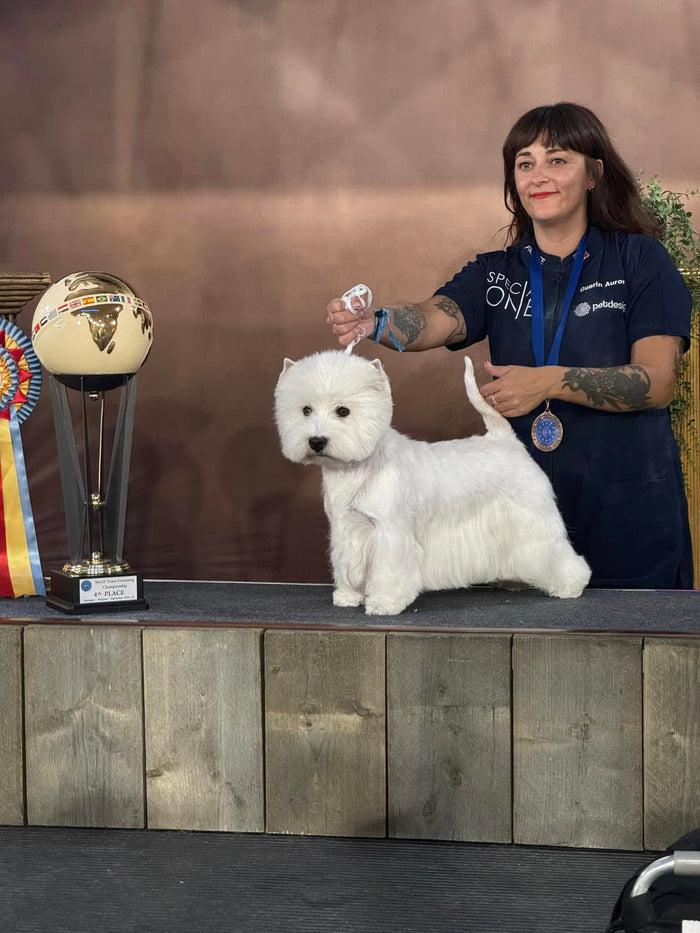
Aurore Guérin's training in Belgium & Special One France on Petdesign.fr
Perfect your technique with Aurore Guerin, a grooming champion! Dog grooming enthusiasts, this training da...

Perfect Poodle Grooming: Expert Advice for an Impeccable Coat
Do you own a poodle and are looking for the best grooming tips? You've come to the right place! In this art...
Réagir à cet article