
Skip to content

Cart

Your cart is empty

News

Dogs: Poodle

17 mars 2022 10 min de lecture
Chiens : Caniche

Dogs: Poodle

Do you have questions about the Poodle? This is the place!

If you can't find what you're looking for, send us a message in the chat.

Is there a history of the Poodle?

Its early days in the dog world were extremely low-key, in France as well as in England and Germany. Attention was focused on hunting dogs, while other working breeds, such as shepherd dogs, also attracted a certain amount of interest. As for companion breeds, often associated with sleeve dogs and ladies' dogs, they were treated with condescending contempt. This is a situation that has not disappeared, with the ninth group still having to endure a certain degree of ostracism.

In France, the Poodle appears to have been a very popular type of dog in the 19th century, judging by numerous accounts from the period. The official figures are less revealing. Although the first registration in the French Stud Book dates from 1885, three years after the creation of the LOF, which was mainly devoted to British hunting breeds, it is worth noting that among the first thousand registrations, only nine concerned Poodles!

The breed was not fundamentally better treated at first in Great Britain, although a Poodle Club was established as early as 1876: six registrations in the second volume of the 1874 Kennel Club studbook (there had been none in the year it was founded, 1873). But English breeders quickly took the initiative. Thus, in the 1920s, when French breeding became organized, it did so using dogs imported from England!

However, in 1936, the Fédération Cynologique Internationale finally considered the case of the Poodle and decided to assign it French nationality, much to the dismay of German breeders who had established a standard (traces of it can also be found in old French works, such as that of veterinarian Dr. Heuillet).

In fact, it must be acknowledged that there is a very ancient curly-coated dog type that is the origin not only of the Poodle and the Barbet, but also of other breeds that have recently been grouped under the designation of water dogs. This type appears to have originated in North Africa and is thought to have reached Europe mainly via the Iberian Peninsula.

This African dog spread both as a herding and water dog, helping fishermen as well as hunters. But as a small companion dog? In the 15th century, there were paintings showing small dogs groomed like lions. The emergence of the modern Poodle dates rather to the 18th century, although its family tree cannot be reconstructed with certainty.

Today, it can be seen that the Moyen Poodle, the link between the Standard and the smaller varieties, which was and remains a French specialty, has become marginalized. This is true both among the general public and in English and American breeding, where the Standard and Moyen have been grouped into a “standard” category that favors larger dogs. Thus, the Standard Poodle, formerly very rare, is now notable in France for its size (officially up to 62 cm) and its long strides. This great athlete could rekindle interest in the breed, although the public tends to prefer a dog that is not bulky and does not require demanding maintenance. The Poodle probably needs to renew its image. The revival will come from elsewhere, as it has since the beginnings of the dog fancy: recognition of gray in 1960, apricot in 1977, English grooming in 1981, and the Toy in 1984. The official arrival of the Toy and apricot varieties enabled LOF breeding to prosper until 1990. The Poodle is subject to fashion and cannot remain in the spotlight by relying exclusively on classic styling, in black, Moyen, and continental grooming.

Does the Poodle have good health? 

Patellar luxation and other joint problems: like other widespread small breeds, this malformation occurs in Poodles, somewhat like hip dysplasia in large breeds. Some dogs may also be affected by ruptured anterior cruciate ligaments. Cases of herniated discs have also been reported. Dental problems: good oral hygiene is essential to prevent tartar and dental abscesses. Cryptorchidism: this condition primarily affects Toy Poodles. Progressive retinal atrophy: across the Channel, cases of progressive retinal atrophy have been reported in certain bloodlines; this problem also exists in France.

How to groom your Poodle quickly and effectively?

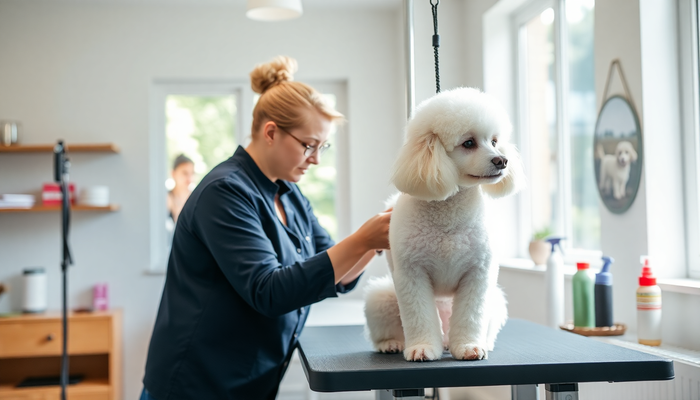
Here is my grooming advice for spectacular results:
✔️ Shampoo: Aquarosa Pro
✔️ Conditioner: Aqua Dolce ​
✔️ Finishing/brushing/detangling spray: Mix Pink 
If you need to achieve maximum volume, for a dog show for example, here is my advice: spray Style 360 onto the coat during and after blow-drying.

New: 4Poodle Pro & Absolute 4Poodle

4Poodle Pro shampoo is rich in ceramides and cashmere proteins and is white like milk. Its neutral color allows you to add drops of dye in different shades and create colored shampoo for every poodle color. 
We brush all the hair, using Absolute 4Poodle antistatic conditioner each time. Don't forget: do not apply conditioner to the hair on the head and neck if you need to use hairspray, as you will have difficulty spraying it!

How many poodles are there?

While we still see just as many Poodles on the streets and in classified ads, the number of Poodles registered with the LOF has fallen by more than 60% over ten years! Thus, on the one hand, the Poodle appears to be the most widespread type of dog in France, with a total population perhaps reaching or exceeding 1.5 million, while on the other, it has been overtaken by the Shih Tzu and the Cavalier King Charles Spaniel, whose recognition among the general public is incomparably lower than its own. 
Yet nothing of this announced decline is perceptible at shows. Consulting the annual list of championship titles awarded internationally, one might believe that the Poodle is currently among the most fashionable breeds. But the dog world is a universe apart, and while buyers do not hesitate to choose among breeds newly discovered and selected by specialists, the latter rarely take the preferences of the majority of dog owners into account.
Yet it seems entirely irreplaceable in today’s context, in which what is sought is an outgoing, easygoing, sturdy, space-saving companion dog—not necessarily tiny—whose ownership entails only a minimum of constraints.
From this perspective, the Poodle is anything but a “has-been.” Its grooming is not really a burden once you have decided to sign up with a reputable grooming salon. Groomed regularly, the Poodle otherwise requires little care, its appearance always remains acceptable, and it never sheds hair on armchairs or carpets.
Because of highly chaotic breeding, in which the best is buried beneath the worst, one sometimes gets the impression that the breed has many health problems. On the contrary, it is surprising to see so many of them, with or without papers, that have sailed past fifteen years without ever visiting the vet for anything other than booster vaccinations. Poodles often age well—that is a fact. And—and this is also one reason for their enormous popularity—they reproduce without difficulty.
Watch the teeth, particularly in smaller dogs, as they can develop tartar very quickly, leading to premature loosening. As for temperament and training, there is nothing to criticize: if treated like a real dog and properly trained, it is a very pleasant companion that understands everything immediately. If the Poodle did not exist, it would have to be invented!

The Poodle’s look

Its coat is so dense and long that you can do just about anything with it. From there, every fantasy is possible, and they have all been explored. But let us remember that it is above all a dog—and even a well-built one—from which its hunting origins can still be discerned.
Although the coat, its colors, its trims, and their maintenance monopolize attention, one should not forget that there is a dog underneath. A well-built dog with balanced, very elegant lines, but without excessive refinement. The harmony of its build is more apparent in the medium and large sizes, whose athleticism is obvious, but the miniature and toy varieties are also built for movement. Whatever their size, Poodles move with lightness.
Not only do they move, but they also skip and leap: it is as though they were mounted on springs. This energetic quality is not merely a matter of temperament and nervous impulses; it is physical!
Let us look more closely at the head, which is very elegant and refined but not underdeveloped, with a typical frontal furrow, a very prominent occipital crest, and a barely marked stop. The eyes are not round but slightly oblique and almond-shaped. They shine like jet, except in brown Poodles, whose gaze is amber. The Poodle has almost entirely forgotten its hunting past, but its well-developed nose, with widely open nostrils, and its long, low-set ears betray genuinely hunting origins. Naturally, its very curly, exceptionally thick and abundantly developed coat lends itself to every kind of fantasy. Every era has had its fashion. There was a time when the corded Poodle was a must. Today it is so rare that one may wonder whether it will disappear. It has also been seen in zouave and zazou styles, with macarons, in seaside trims—renamed “Saint-Trop” or “Bermuda” in the 1960s and 1970s—or in the Dutch style. In the German version, it was the Royal Dutch (rzc), characterized by large “boleros.” 
The classic trim, known as the continental trim, was joined in 1981 by the English trim, with a topknot on the skull and a hindquarters that was no longer bare but sculpted into pompons. For about the past ten years, this English trim has evolved into the “puppy” trim, with the hind and forelegs wearing trousers. In fact, there is now only one pompon, on the tail. Show and street Poodles have ultimately evolved in parallel toward greater sobriety—except that show Poodles have a huge topknot resting on a more discreet coat. But whether they have more or less hair, depending on whether they are meant to put on a show or live a normal life, why should the Poodle not remain a dog with balanced proportions, capable of showcasing its vitality and dynamism?
Its coat is so dense and long that you can do just about anything with it. From there, every fantasy is possible, and they have all been explored. But let us remember that it is above all a dog—and even a well-built one—from which its hunting origins can still be discerned.
Although the coat, its colors, its trims, and their maintenance monopolize attention, one should not forget that there is a dog underneath. A well-built dog with balanced, very elegant lines, but without excessive refinement. The harmony of its build is more apparent in the medium and large sizes, whose athleticism is obvious, but the miniature and toy varieties are also built for movement. Whatever their size, Poodles move with lightness.
Not only do they move, but they also skip and leap: it is as though they were mounted on springs. This energetic quality is not merely a matter of temperament and nervous impulses; it is physical!
Let us look more closely at the head, which is very elegant and refined but not underdeveloped, with a typical frontal furrow, a very prominent occipital crest, and a barely marked stop. The eyes are not round but slightly oblique and almond-shaped. They shine like jet, except in brown Poodles, whose gaze is amber. The Poodle has almost entirely forgotten its hunting past, but its well-developed nose, with widely open nostrils, and its long, low-set ears betray genuinely hunting origins. Naturally, its very curly, exceptionally thick and abundantly developed coat lends itself to every kind of fantasy. Every era has had its fashion. There was a time when the corded Poodle was a must. Today it is so rare that one may wonder whether it will disappear. It has also been seen in zouave and zazou styles, with macarons, in seaside trims—renamed “Saint-Trop” or “Bermuda” in the 1960s and 1970s—or in the Dutch style. In the German version, it was the Royal Dutch (rzc), characterized by large “boleros.” 
The classic trim, known as the continental trim, was joined in 1981 by the English trim, with a topknot on the skull and a hindquarters that was no longer bare but sculpted into pompons. For about the past ten years, this English trim has evolved into the “puppy” trim, with the hind and forelegs wearing trousers. In fact, there is now only one pompon, on the tail. Show and street Poodles have ultimately evolved in parallel toward greater sobriety—except that show Poodles have a huge topknot resting on a more discreet coat. But whether they have more or less hair, depending on whether they are meant to put on a show or live a normal life, why should the Poodle not remain a dog with balanced proportions, capable of showcasing its vitality and dynamism?

Our Shopping List for Spitzes


Here is a selection of the products we offer


Partager Lien copié
Passez a la pratique

Retrouvez tous les produits Special One selectionnes par nos toiletteurs partenaires.

Voir la gamme
Échanges

Réagir à cet article