


Dogs: Australian Shepherd
Questions about the Australian Shepherd? This is the place!
If you can’t find what you’re looking for, send us a message in the chat.
What is the history of the Australian Shepherd?
Here is another breed whose origins are the subject of numerous, often contradictory theories. Nevertheless, one fact can be stated with absolute certainty: it belongs to Section 1 of Group 1 in the FCI nomenclature, since its function is that of a herding dog for the farm or ranch.
But let’s get back to our sheep—is it possible to put it better when talking about a herding dog? The various “schools of thought” agree on at least one point: whether Australian or North American, the Aussie is said to be descended from Basque herding dogs. Oh yes, then this American-Australian shepherd must be at least a little French (hooray!) or Spanish, since the Basque Country straddles the border after all?
The brief historical overview included in the breed standard tells us that “... the breed, as we know it today, developed exclusively in the United States. The name Australian Shepherd was given because of its association with Basque shepherds who arrived in the United States in the 19th century from Australia...” Yes, but what were these Basques doing in Australia? A few centuries ago, apart from a few privileged dogs that were companions to the nobility or an elite, a dog was accepted only according to its purpose. Wherever there were flocks, dogs were needed to guard them—that was obvious. During two of his expeditions to the “New World,” Christopher Columbus had already brought sheep to North America. British settlers later did the same, landing with their sheep, as did the Spanish, who introduced the Merino breed and its incomparable wool.
All these immigrants from various European countries and their sheep were, of course, accompanied by their herding dogs of many different breeds. Moreover, they had not limited themselves to North America but had also “colonized” Australia, since the arrival of French, German, Irish, and Welsh immigrants was recorded as early as the 1700s. So who knows exactly which breeds our modern Aussie descends from? In fact, its origins must involve a mixture of European herding dogs, to which native breeds became mixed—whether spontaneously or otherwise!
What is certain is that the breed, as we know it, established itself very successfully in the United States long ago because of its various qualities, which we will discuss a little further on. The great plains of the West, until then devoted to raising horses and cattle but later opening up to sheep, proved to be its ideal home, and it is reported that many legendary cowboys owned Aussies, including Tom Mix and Roy Rogers.
But the Aussie has more than one trick up its sleeve and more than one skill, as demonstrated by the tours of Jay Sisler, a famous dog trainer from Idaho (he acquired his first Aussie in 1939), who for many years performed with his Aussies at rodeos, delighting audiences with the perfect training of his "artists." Although their routines were more like circus acts, they undoubtedly contributed greatly to making the breed known and appreciated in both the United States and Canada.
Some of Jay Sisler's dogs captivated Walt Disney, who made them big-screen stars, including "Shorty" (1948–1959), a handsome Blue Merle in "Cowdog"; "Stub" in "Stub, the Best Cowdog in the West"; and "Silver" in "Run, Appaloosa, Run." Since the troupe needed to be replenished, Jay Sisler and his brother Gene did some breeding, and it cannot be denied that their offspring, although not extremely numerous, formed the foundation of modern bloodlines, to which they passed on their intelligence, trainability, and enthusiasm for work.
Is the Australian Shepherd a healthy breed?
Like many other breeds, the Aussie is among those that can develop eye problems or disorders. Some conditions are hereditary, while others are not; some appear at a young age, while others develop later. That is why it is recommended that the eyes of dogs intended for breeding be examined annually by a veterinary ophthalmologist.
How can the gene responsible for the beautiful Merle coloring, so prized in the Aussie, also affect the development of the eye or ear during the fetal stage? We do not know. In her excellent book (if you read English, do not deprive yourself of this joy and enrichment!) "The Australian Shepherd - Champion of Vers-tility" (Howell Book House), Liz Palika states that when a Merle male is bred to a Merle female, one puppy in four will suffer from an eye or ear disorder. As for Collie eye anomaly (which can also affect the Aussie), the Australian Shepherd Club of America recommends that puppies be examined before four months of age.
And, of course, the hips of prospective breeding dogs should also be X-rayed to detect any possible dysplasia.
Above all, do not let these possible conditions discourage you; they are common among many breeds. If you buy a healthy puppy from healthy parents and raise it in a healthy environment, years of work and shared enjoyment await you!
How do you groom your Australian Shepherd quickly and effectively?
Here are my grooming tips for spectacular results:
✔️ Shampoo: Aquarosa Pro
✔️ Conditioner: Aqua Dolce
✔️ Finishing, brushing, and detangling spray: Mix Pink
How do I train my Australian Shepherd properly?
Its versatility seems to be one of the main qualities that Aussie owners agree their dogs possess. They also say that the Australian Shepherd is intelligent and eager to please its owner—excellent foundations for training a working dog!
To complete the picture, we must not forget its courage, endurance, unwavering devotion to its owner, stable temperament, sociability with other dogs, and the bond it forms with children, for whom it is an excellent playmate, among other qualities. Its “aficionados” never run out of praise and appreciate its somewhat reserved nature during initial encounters.
This rugged, athletic dog has everything a working dog needs: its behavior matches its physique. But there is a downside: the Aussie cannot thrive if it has to live in an apartment and make do with short walks on a leash. It is a dog of action and open spaces, not a city dog. So if you cannot provide the living conditions its deep-rooted nature requires, do not get one.
Nor is it a kennel dog; it needs to live with its human “family.” After a good day’s work, nothing suits it better than being at home and in close contact with those it loves, but it will demand your attention and insist on following you absolutely everywhere like a shadow. Before getting up from your chair, you will always have to make sure you do not step on your dog.
Paradoxically, although it is an excellent companion, it should not be mistaken for an ordinary companion dog; that is not its purpose at all. It needs to feel useful and to work. If you cannot satisfy this pressing need, the Aussie will find something to do, and then you will not be prepared for the surprises in store. It may dig up the garden (something it is less inclined to do if it gets enough physical activity), chase your cats, or simply bark at the neighbors just to pass the time... These nuisances, caused by idleness, can be avoided through proper training: this dog enjoys living in the home, so above all you must teach it the rules of communal living and the boundaries it must not cross, starting at a young age.
The first rule it must learn is the hierarchy. It is essential that it understand, and above all accept once and for all, that its owner is at the very top of the ladder: the unquestionable pack leader. The rest of the family comes next, while the dog, at the bottom of the ladder, is the very loyal but obedient subject.
If you do not feel you have the courage, patience, and perseverance necessary to provide thorough training, there is no point in getting an Aussie. Its mind must be kept occupied; otherwise, rest assured that it will display extraordinary ingenuity to relieve its boredom. It will quickly figure out how to open doors—especially cupboard doors—and do not be surprised to find it sitting on the kitchen counter; remember, it is an athlete...
But if you enjoy getting involved in training, work, or dog sports, you will not find a better companion than the Aussie. Although originally bred to herd livestock—whether cattle, sheep, or ducks—its versatility also enables it to excel in other areas, such as obedience and agility. In the United States, some even serve as guides for people who are blind or visually impaired, deaf or hard of hearing; others make life easier for people with disabilities, join therapy teams, visit nursing homes, and so on. One might even wonder whether there is anything an Aussie truly cannot learn to do.
First, you will need to train your Aussie to walk on a leash, at heel, without pulling, in public places and in crowds, and it must show no emotion. It must also remain seated on command without moving (even if you spend time talking to someone), allow a stranger to approach without reacting, and even let that stranger touch it without jumping on them (even affectionately!), growling, or barking. In all these situations, whenever it has performed well, remember to praise it warmly; it will be very responsive to this.
Every training session should be interrupted by short periods of play so that it can let off steam, but at your first request it must understand that playtime is over and work must resume.
If you do not feel capable of successfully completing this initial training, enroll quickly in a training club and discover your student's abilities.
The first discipline you will need to work on is, of course, Obedience; it forms the foundation for all other types of training. Indeed, how can you undertake Agility—or any other discipline—if you are not sure how your dog will react? You must be able to control it 100%, especially when it is off leash.
Once this stage is complete, you can move on to Agility, which will help your Aussie gain confidence in itself, its abilities, and you. You will learn to communicate with your dog and explain what you expect from it.
In these two disciplines, Obedience and Agility, if your dog is talented, you have the courage, and you are willing to invest in entry fees, then competitions await—and who knows, perhaps even prestigious titles?
Since the Aussie is truly versatile, nothing prevents you from training it in tracking, IPO, and above all herding trials, which was its original purpose—and rest assured that its strong instinct will be a great help. It will amaze you with its innate talents: it will follow your commands, but will also be capable of taking the initiative when necessary, unlike not all herding breeds. Hardy and courageous, it will be able to prove itself equally well with a flock of ducks, geese, sheep, or even cattle.
Our Shopping List for the Australian Shepherd
Here is a selection of the products we offer
Passez a la pratique
Retrouvez tous les produits Special One selectionnes par nos toiletteurs partenaires.
Voir la gammeA lire ensuite
Continuez la lecture
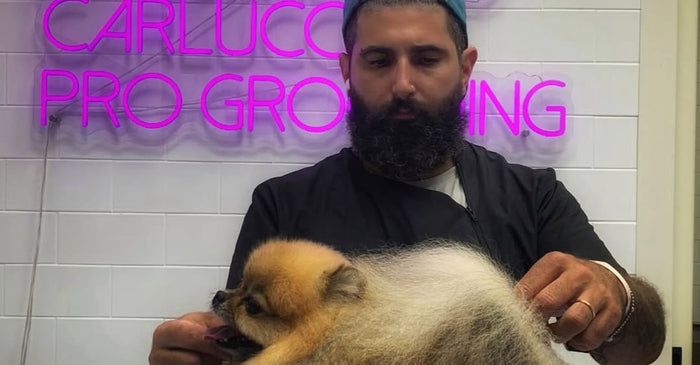
1 mars 2025
Training in Belgium by Massimiliano Carluccio & Special One France on Petdesign.fr
✨ Perfect your grooming with Massimiliano Carluccio! ✨ Do you dream of excelling in the art of dog groomin...
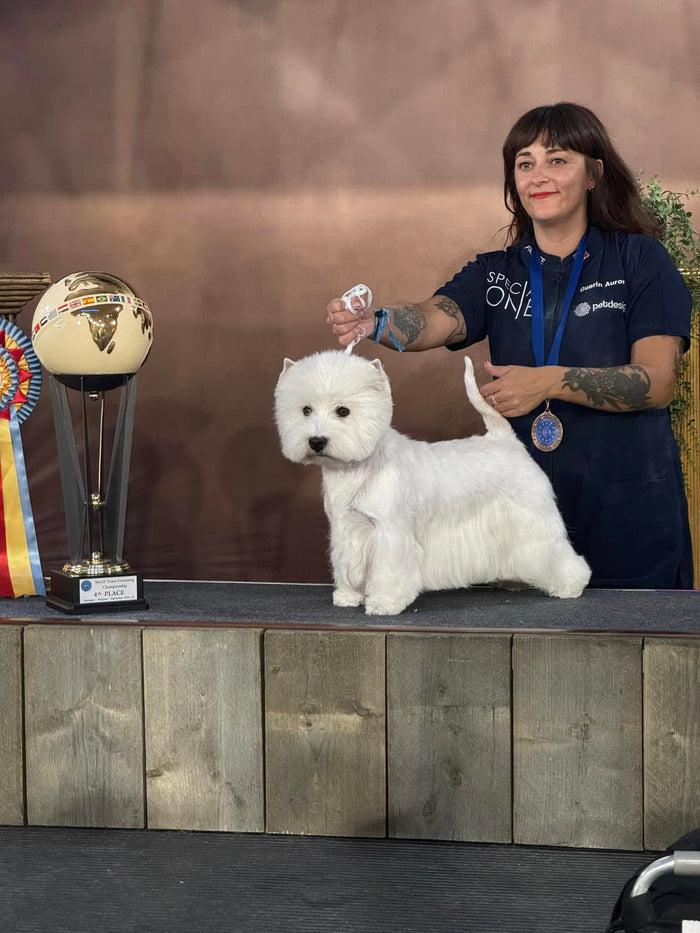
31 janvier 2025
Aurore Guérin's training in Belgium & Special One France on Petdesign.fr
Perfect your technique with Aurore Guerin, a grooming champion! Dog grooming enthusiasts, this training da...
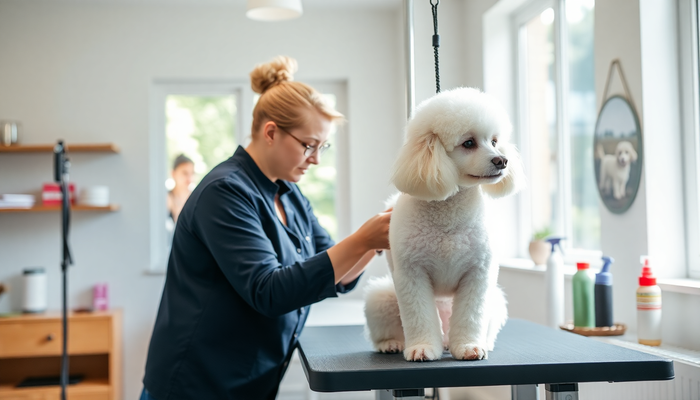
14 janvier 2025
Perfect Poodle Grooming: Expert Advice for an Impeccable Coat
Do you own a poodle and are looking for the best grooming tips? You've come to the right place! In this art...
Réagir à cet article